
Last updated: November 19, 2026
Budget airlines use sizing bins, gate staff, and boarding pass checks to catch carry-on bags that look too large. For Carry-On Fit Checks for Budget Airlines with Strict Enforcement, the quick answer is simple: measure your bag against the airline’s stated dimensions before you leave, and expect a gate check if it is even slightly over. The steps below show how to avoid a last-minute fee and a forced gate check.
Key Takeaways
- Budget carriers look at shape, not just the tag on your bag.
- A bag that fits at home can still fail if the wheels, handle, or side pockets push it past the bin.
- Ticket class and priority boarding can change what you’re allowed to bring.
- Soft-sided, underpacked bags are easier to place in a sizing bin.
- Check your bag against the airline’s stated dimensions before you leave.
What budget airlines check at the gate

Budget airlines check whether your bag fits the airline’s size box, not whether it “seems close.” Picture this: you’re at the gate with 10 minutes before boarding, and a staff member points to a metal sizing bin beside the scanner. If your carry-on needs a shove, a tilt, or a lucky angle, that is the problem.
Most strict carriers use a sizing bin or metal frame at the gate. Some also compare your bag with the details tied to your boarding pass and fare type. The bag can pass at one airport and fail at another if staff are enforcing more closely that day.
The catch is that the rules are not just about the main body of the suitcase. Wheels, handles, hard shells, side pockets, and even overstuffed zippers can create the extra centimeters that trigger a gate check. A soft bag with the right dimensions is usually easier to place in the bin than a rigid shell that is packed full.
If you want a wider baseline for measuring and packing, the hub guide on carry-on size rules and fit checks belongs before this page, not inside it. This page is about the enforcement side — the part that turns a rule on paper into a fee at the gate.
Common check points:
- bag height, width, and depth
- wheels and extended handles
- bulging front pockets
- ticket class or fare bundle
- priority boarding status
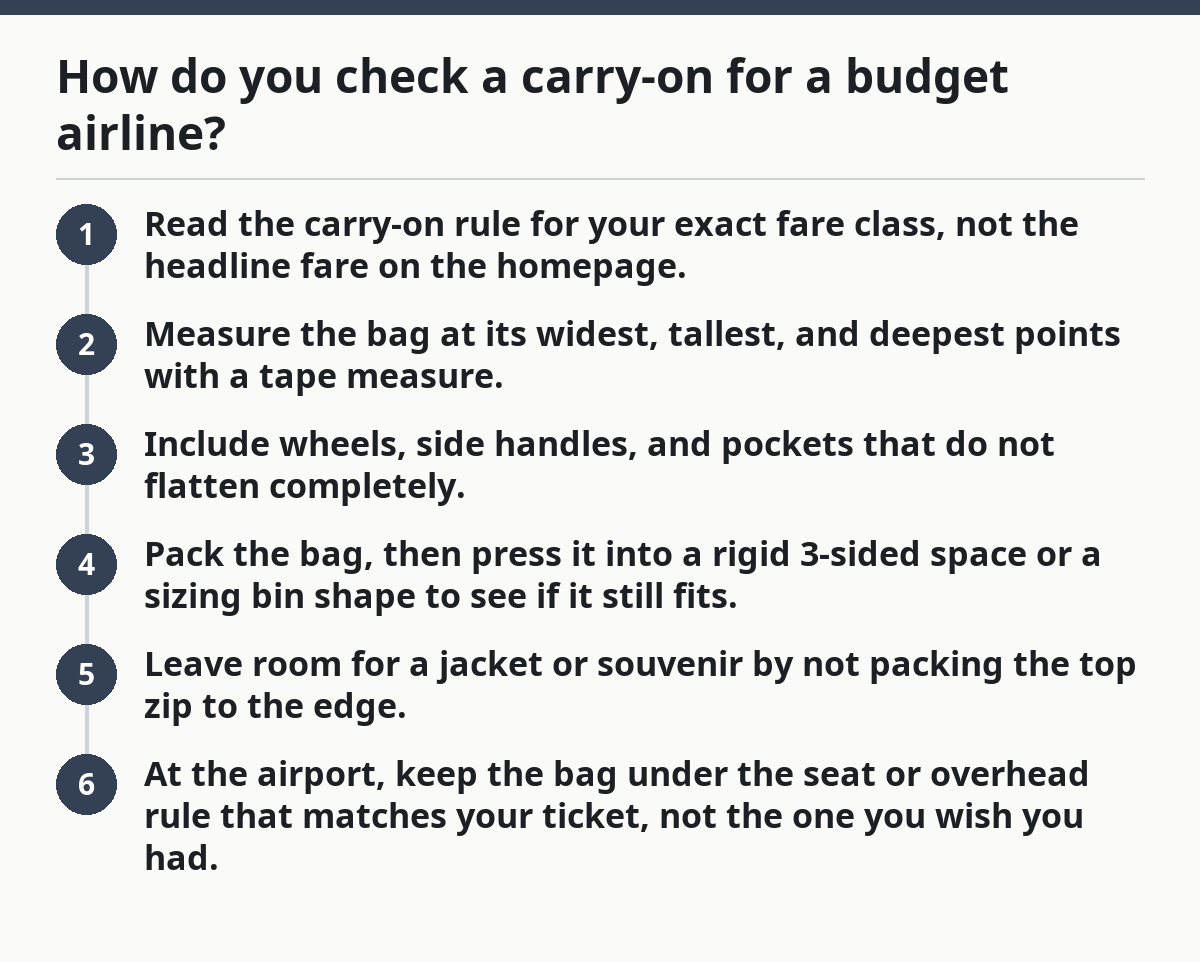
How do you check a carry-on for a budget airline?
You check a carry-on by measuring the full bag, comparing it to the airline’s stated limit, then testing it in a bin-like space before you fly. Picture this: your suitcase sits open on the floor, and you can see the zipper strain near the top. That strain is what turns into trouble at the airport.
Start with the airline’s published limit for your fare class. Some budget airlines allow different carry-on rights by fare class, priority boarding, or bundle upgrades. Then measure the bag with all fixed parts included — wheels, feet, and any hard edges.
Use this as a simple procedure:
- Read the carry-on rule for your exact fare class, not the headline fare on the homepage.
- Measure the bag at its widest, tallest, and deepest points with a tape measure.
- Include wheels, side handles, and pockets that do not flatten completely.
- Pack the bag, then press it into a rigid 3-sided space or a sizing bin shape to see if it still fits.
- Leave room for a jacket or souvenir by not packing the top zip to the edge.
- At the airport, keep the bag under the seat or overhead rule that matches your ticket, not the one you wish you had.
A good home check is not about perfection. It is about removing the obvious risks before the gate staff does the same in 30 seconds. If the bag barely fits after you press it down, that is a warning, not a pass.
A soft duffel or a lightly packed spinner gives you a little margin. A hard case packed to the zipper gives you almost none.
Why strict enforcement catches people who “know the rules”
Strict enforcement catches people because the airline enforces the bag you bring, not the bag you planned to bring. Picture this: you read the size limit, assume your case is “close enough,” and then the gate staff asks you to drop it into the metal frame. That frame does not care about intent.
The biggest mistake is trusting the printed dimensions alone. A bag marked 55 x 40 x 20 cm can still fail if the wheels sit proud, the top expands, or the side pocket fills out after packing. On budget airlines, that margin matters more than most travelers expect.
Another trap is thinking every airport handles checks the same way. Some gates inspect a few bags. Others check nearly every oversized-looking carry-on. A full boarding area, a late flight, or a crew focused on speed can make enforcement feel harsher than the rule sheet suggested.
Here’s the catch: “strict” usually means the airline has a simple system and staff are told to use it. That system may include a yellow tag, a size bin, or a quick visual check before boarding starts. If the bag looks even slightly over, you lose the argument at the gate.
What strict enforcement usually means:
- staff may ask for a bin check
- oversize bags can be charged at the gate
- bulky personal items may be counted as carry-on
- priority boarding does not erase the size limit
- bag shape matters as much as weight
Which ticket classes change your carry-on rights?
Your ticket class can change the answer before your bag ever reaches the bin. Picture this: two passengers bring the same 20-inch suitcase, but one bought a basic fare and the other paid for a bundle with priority boarding. The baggage rules are not the same.
Budget airlines often split carry-on rules by fare type. A basic ticket may allow only a small personal item, while a higher fare or priority package may include a larger carry-on bag. Some carriers also let premium or loyalty passengers bring an extra cabin item without a gate fee.
The boarding pass matters because the fare code tells staff what you bought. If you upgraded later, the rule on your booking confirmation should match the rule on the day of travel. If the two do not line up, fix it before you reach the airport.
The truth is, a lot of carry-on problems are fare problems in disguise. People pack for the better ticket they thought they had, then stand in line with the cheaper one they actually booked. That mistake is expensive because it shows up when the airline has the least time to negotiate.
Check these details before you pack:
- fare bundle name
- allowance for a personal item
- allowance for a larger cabin bag
- priority boarding terms
- whether your route has a different rule set
What bag shapes pass fit checks more easily?
Soft-sided bags pass fit checks more easily than hard-shell cases because they give under pressure. Picture this: your bag is almost full, but the fabric still flexes when you press it into a metal frame. That flex is the difference between a clean fit and a gate check.
A rectangular soft bag is usually easier to use than a rigid suitcase with fixed corners. A duffel with a flat base can also work well if you do not overpack it. Hard-shell cases are the least forgiving because their shape stays the same even when the zipper strains.
Leave the outer shape clean. Avoid dangling straps, stuffed front pockets, and items clipped to the outside. A water bottle, a duty-free bag, or a folded coat hanging from the handle can make the bag look larger than the measurement suggests.
Good packing is mostly about keeping the silhouette tight. Clothing fills gaps better than loose, bulky items. That does not mean cramming more into the bag. It means giving the bag a shape that survives a quick gate check.
Better fit choices include:
- soft-sided cabin bags
- underpacked spinner cases
- duffels with flat bottoms
- bags without bulging exterior pockets
- luggage with recessed wheels
What happens if your bag does not fit?
If your bag does not fit, the airline can make you check it and charge a gate fee. Picture this: you place the bag in the sizing bin, it sticks halfway out, and the staff member points you toward payment or the bag drop line. That is the moment the airport gets expensive.
The exact outcome depends on the carrier, the route, and the fare rules, but the pattern is the same. A bag that fails the fit check may be tagged and sent to the hold. In many cases, the fee is higher at the gate than it would have been if you had paid earlier.
Do not try to force the lid or compress the bag past the point where it closes naturally. That can leave you with a broken zipper, damaged wheels, or a bag that is too tight to close again after inspection. If you are carrying fragile items, move them before the airport rather than gambling on a last-second squeeze.
If the bag is close, make it smaller before you leave home, or choose a fare that includes the size you need. The failure point is usually obvious once the bag is packed, and that is the time to fix it.
If the bag fails, expect one of these:
- gate-check fee
- baggage tag added at the boarding area
- bag sent to the cargo hold
- delay while payment is processed
- possible repacking at the gate
How to reduce surprises before you reach the gate
You reduce surprises by treating the airline’s rule as a hard limit, not a suggestion. Picture this: you are standing in your room with a tape measure, a half-packed suitcase, and your boarding pass open on your phone. That is the cheapest place to solve the problem.
Use a 10-minute preflight check the night before travel. Confirm the fare class, measure the bag, pack it fully, and see whether the zipper closes without force. If the bag barely passes at home, it is not safe for a strict gate.
The most useful habit is to pack one version of the trip, not three. If you keep “just in case” extras in every pocket, the bag grows fast. A budget airline can turn that extra volume into a fee in under a minute.
For a broader step-by-step on dimensions and bag math, the main hub on carry-on size rules and fit checks is the right next read. This page is the airport reality check; that one covers the measurement side in more depth.
Use this final check:
- can the bag stand in a sizing bin without pressure?
- do wheels and handles stay inside the limit?
- does the fare include the bag you packed?
- can you move one item to a personal item?
- would a softer bag solve the problem?
Why do budget airlines check carry-on size more often?
Budget airlines check carry-on size more often because extra cabin bags affect boarding speed, overhead space, and revenue. They sell lower base fares and charge more when a bag breaks the rules, so the gate check is part control, part fee collection.
Strict checks also help keep boarding lines moving. A sizing bin is faster than a long argument about whether a bag is “close enough,” which is why staff often rely on it instead of guessing by eye.
Do budget airlines allow a personal item too?
Yes, many budget airlines allow a personal item, but the size and placement rules can be tight. A small backpack, purse, or laptop bag may count as the only free item on a basic fare, while a larger carry-on costs extra.
The key point is that a personal item usually has to fit under the seat. If it is too tall, too deep, or stuffed past the limit, staff may count it as an extra cabin bag.
What happens if my bag does not fit?
If your bag does not fit, the airline can require you to check it and pay the gate fee. The bag may be tagged at the boarding area and moved to the hold before the flight leaves.
If you are close to the limit, the best fix is to repack before the gate rather than argue there. Once the sizing bin says no, the airline’s position is usually final.
Drafted with AI; not yet reviewed by a person.




Leave a Reply