
Last updated: October 24, 2026
Key Takeaways
- Carry-on luggage size is the bag’s outside dimensions, not the space inside it.
- Measure the full exterior, including wheels, feet, handles, pockets, and any shape changes.
- Use your ticketing airline’s rule for your exact route and fare, not a size that worked before.
- The costliest error is trusting the label instead of the outside measurement, which can trigger gate-check fees.
Carry-on luggage usually has to fit a carrier’s published size limit, clear the sizer at the gate if one is used, and still leave room for wheels, handles, and anything packed inside. The Carry-On Size Guide: Airline Rules, Measurements, and Fit starts with that basic rule because “fits” is not the same as the number on the tag, and airlines do not measure the same way unless they say they do.
In short: the bag that flies is the one that stays within the airline’s total linear dimensions after you account for the outer shell, wheels, handles, and bulges. If you buy or pack by the label alone, you can end up with a bag that looks fine in a store and fails at boarding.
What carry-on luggage size really means
Therefore, carry-on luggage size means the outside dimensions of the bag, not the amount of space you can stuff into it. Most airlines publish a maximum height, width, and depth, and the gate agent is looking at the bag’s actual exterior shape, including hard edges, telescoping handles, and fixed wheels.
That distinction matters because a 22-inch suitcase is not automatically a 22-inch carry-on. Many brands measure only the main shell. The wheels can add an inch or two, and the handle housing can add more. A soft-sided bag can also swell past its label if it is overpacked by even a few centimeters.
Common airline carry-on dimensions are often in the neighborhood of 22 x 14 x 9 inches, which includes wheels and handles for many U.S. carriers, but there is no single universal rule. International carriers can be stricter or use metric limits such as 55 x 40 x 20 cm. A bag that is acceptable on one route may be too tall, too deep, or too wide on another.
Because of that, if a bag is close to the limit, treat the smallest listed dimension as the one that matters most, and check the airline’s baggage page or a travel professional before you rely on a borderline size. Depth is usually the easiest to violate after packing, especially if the zipper profile is rounded or the front pocket is stuffed.
Two terms matter on every airline page: carry-on and personal item. A carry-on is the larger bag meant for the overhead bin. A personal item is the smaller piece that goes under the seat, such as a laptop bag or small backpack. The airline may allow both, but each has its own measurement cap.
For a general reference on cabin baggage dimensions, IATA publishes guidance that many airlines use as a starting point: International Air Transport Association (IATA) Recommended Cabin baggage dimensions. It is not a guarantee for every carrier, but it helps explain why many limits cluster around similar sizes.
How to measure luggage the way airlines do
Next, measure the bag from the outside edges, and include wheels, feet, handles, pockets, and anything that changes the bag’s shape. The number on the product page is often not enough.
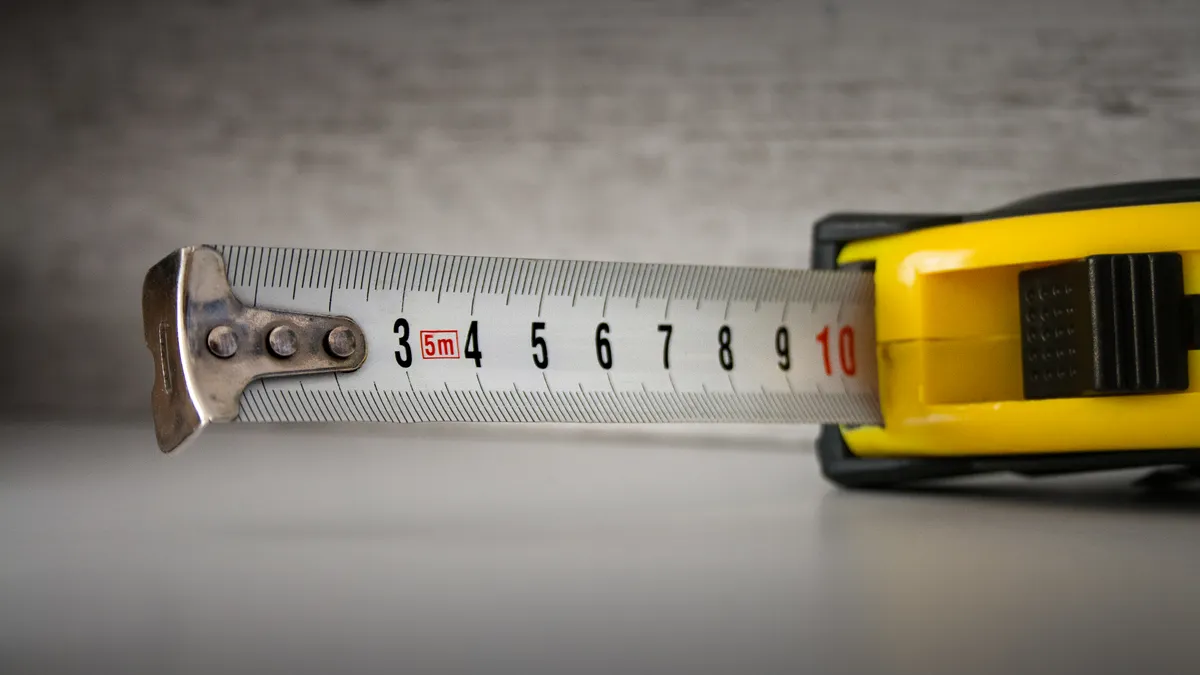
Use a tape measure, not a ruler held at an angle. A soft tailor’s tape works best because it follows the shape of a rounded shell. If you have a rigid suitcase, place it upright on a flat floor and measure straight across the tallest, widest, and deepest points. If the top handle sticks up, measure to the highest point when the handle is fully retracted, unless the airline explicitly says otherwise.
Here is the simplest way to do it:
- Stand the bag on a flat floor with nothing leaning on it. You want the true outer shape, not a compressed version.
- Measure height from the floor to the highest fixed point, including wheels and feet. This is the number that usually gets a bag rejected first.
- Measure width across the widest side, including side pockets or a molded zipper curve. A soft pocket can add 1 to 2 inches when filled.
- Measure depth front to back at the thickest point, including bulges from the main compartment and any outside pocket.
- Add the three numbers only if the airline uses total linear dimensions. If the airline publishes separate height, width, and depth limits, compare each number on its own.
- Repeat the measurement with the bag packed the way you travel. A fully stuffed shell can gain enough depth to cross the limit even if the empty bag passes.
One useful habit is to write the measured size on a card and keep it with the bag, or tape a label inside the lining. That helps when a seller lists the bag as “22-inch” but the actual exterior is different. Some airlines use a metal or plastic sizer at the gate, and that box does not care what the product description said.
A tape measure also helps you separate usable space from airline-legal space. A bag with an 18-inch exterior and a curved hard shell may hold less than a soft-sided bag with the same height. That does not make it worse; it just means the shape matters as much as the number.
Airline carry-on dimensions to check before you fly
Therefore, the right size is the one listed on your ticketing airline’s website for your exact route and fare, not the one that worked on a previous trip. That sounds obvious until a traveler books a different carrier, codeshare, or international leg and discovers the size rule changed by several centimeters.
Start with the airline’s baggage page and find three things: the maximum carry-on dimensions, the allowed weight if there is one, and the rules for a personal item. Some airlines publish one size for domestic flights and another for international services. Some also have different rules for premium cabins, basic fares, or regional aircraft.
Do not assume the measurement is the same across alliances or partner flights. A ticket may be sold by one airline but operated by another, and the operating carrier’s rule usually controls the cabin bag size. If the itinerary includes a connection, check each segment. The stricter limit wins if the airline enforces at the gate.
A few practical patterns show up often:
- U.S. mainline carriers commonly publish a size near 22 x 14 x 9 inches, though the exact rule can vary by airline and by whether the airline includes wheels and handles.
- Many international airlines use metric dimensions such as 55 x 40 x 20 cm or a similar variation.
- Low-cost carriers are often stricter and may allow a smaller cabin bag unless you buy an upgraded fare or cabin-bag option.
- Regional jets can force gate-checking even a legal-size bag if the overhead bins are small.
That last point matters. A bag can be legal and still not fit the aircraft’s overhead bin on a smaller plane. A 21-inch roller that slides into a wide-body bin may be awkward on a regional jet with tighter bins and limited under-seat space.
For route planning, IATA’s guidance is useful background, but the airline’s own baggage page is the final word. If you want a second check, many airline and airport pages repeat the same basic dimensions, but the exact flight number and operating carrier still matter before you leave home.
What is the easiest way to choose a bag that fits the overhead bin?
Ultimately, the easiest way is to buy to the smallest published limit you expect to face, then leave a margin of about 1 inch on each side for real-world packing and measurement differences. That margin is not a rule, just a practical buffer.
A bag that measures exactly the maximum on paper can still fail for three common reasons: the wheels extend farther than the seller measured, the handle housing is taller than expected, or the packed bag bulges at the zipper seam. A soft-sided bag can also be squeezed slightly, but not enough to save a bag that is clearly oversized.
I’d use this decision order:
- Check the airline rule first. If the smallest number in your usual travel pattern is 21.5 inches tall, do not buy a 22.5-inch bag and hope for leniency.
- Check the bag’s true outside measurement. Ignore the marketing label if the product page does not clearly state whether wheels and handles are included.
- Check the bag’s shape. Straight-sided bags pack more predictably than rounded shells. A shallow depth is often safer than an extra inch of height.
- Check your own packing style. A structured bag with outside pockets can turn into an oversize bag when those pockets are filled.
- Check the aircraft type. If you often fly smaller regional aircraft, even a legal bag may be awkward overhead.
This is where many “carry-on” buyers make the wrong trade. They pick the largest bag allowed by the airline, then pack it as if it were checked luggage. That usually leads to a bag that is legal in theory and annoying in practice. A slightly smaller case is often easier to place, easier to close, and less likely to be flagged at the gate.
If the bag has expandable zippers, treat that feature with caution and check the airline’s rule or a travel professional before using it. Expansion is useful after the trip, but it creates a size trap on the outbound leg. An expanded bag may no longer meet the airline’s carry-on limit, even if the unexpanded version does.
Personal item size and overhead bin fit are not the same problem
Consequently, a personal item is usually much smaller than a carry-on and is meant to fit under the seat in front of you, while the larger bag is intended for the overhead bin. Those are different spaces with different limits, and confusing them is a common reason people get stopped at boarding.
Many airlines publish a personal item size in inches or centimeters, and the common shapes are a small backpack, slim tote, or laptop bag. The exact limit can be tight enough that a thick camera bag or a stuffed daypack no longer qualifies. If the bag is soft-sided, it may compress under the seat; if it is rigid, it may not.
The overhead bin is the larger storage area above the seat rows, but its usable space depends on the aircraft. A full-size cabin on a wide-body jet offers more room than a narrow regional plane. Even then, bin shape matters. Some bins are deeper than they are tall, and some taper toward the hinges. A legal-size roller may slide in only if it is placed on its side.
Here is the part that most guides leave out: a bag that fits the airline rule can still be awkward for the cabin crew if it blocks the bin from closing cleanly. That is why gate agents sometimes check shape, not just the printed dimensions. The bag’s corners, side pockets, and handles can create a bulky silhouette that is harder to stow than the number suggests.
If you travel with both a larger cabin bag and a personal item, keep the smaller item truly small. A “personal item” that has expanded into a stuffed backpack can draw attention even when the main bag is fine. The rule is not about how much you want to bring; it is about whether both pieces can fit in the spaces the airline assigns.
For a direct, authoritative reference, the Federal Aviation Administration explains cabin storage and safe stowage practices for aircraft passengers on its passenger guidance pages. That is useful for understanding why bags need to stay secure, not just why they need to be the right size.
Common carry-on sizing mistakes that cost you at the gate
Overall, the most expensive mistake is counting the label instead of the outside measurement, because that is what turns a legal-looking bag into a gate-check charge or a forced checked bag. The fix is to measure the bag yourself and compare it to the airline’s published numbers before you leave.
A few other mistakes show up repeatedly:
- Ignoring wheels and handles. Cost: the bag can exceed the height limit by an inch or more. Fix: measure the full exterior, not the interior shell.
- Packing the expansion zipper open. Cost: a bag that was compliant becomes too deep. Fix: keep expansion closed unless you have checked the route’s rule and still have room.
- Using the same bag on every airline. Cost: a bag that works on one carrier may fail on another with a smaller limit. Fix: check each itinerary, especially for international flights.
- Assuming soft-sided bags always pass. Cost: a stuffed soft bag can bulge past the sizer. Fix: pack it to the shape it has when measured, not the shape it has empty.
- Forgetting the personal item limit. Cost: both bags may be challenged if one is oversized. Fix: keep the smaller item slim and easy to slide under the seat.
The honest trade-off here is simple: bigger bags give you more room, but they raise the risk of a mismatch with airline carry-on dimensions. Smaller bags are safer, but they force more selective packing. If you hate surprises at the gate, size conservatively. If you travel on the same airline every week and know its exact rule, you can push closer to the limit.
I would not recommend relying on “close enough” if the trip involves a budget airline, an international connection, or a small aircraft. Those are the situations where the rules are more likely to be enforced exactly.
A quick checklist before you leave home
Therefore, your bag is ready when the measured exterior matches the airline’s published limit, the wheels and handle are included in that measurement, and the packed shape still looks like the bag you measured. That is the shortest reliable check.
Before you head to the airport, run this list:
- Confirm the carry-on dimensions for the actual airline operating your flight.
- Confirm the personal item limit if you are bringing a second bag.
- Measure the bag with a tape measure in its packed state.
- Check that expansion zippers are closed unless the airline allows more.
- Make sure no side pocket, strap, or handle adds a surprise bulge.
- If flying on a smaller aircraft, expect tighter overhead bin space.
If the numbers are close, it is safer to pick the smaller bag. A bag that passes by half an inch on your floor can fail in a gate sizer if it is filled differently or compressed differently. That is not airline cruelty; it is the difference between a published dimension and a real object.
The smartest carry-on choice is not the biggest one you can find. It is the one that fits the airline’s published rule, the overhead bin, and your actual packing style at the same time.
What size luggage counts as carry-on?
In practical terms, a carry-on counts as the bag size your airline publishes for cabin storage, usually expressed as maximum height, width, and depth. The bag has to include wheels, handles, and any fixed parts in that measurement.
Drafted with AI; not yet reviewed by a person.





Leave a Reply