

Last updated: November 18, 2026
Quick answer: carry-on weight limits vary by airline type, and many budget carriers set limits around 7 kg to 10 kg. This guide shows you how the rules tend to differ, how to weigh a packed bag, and what to do before you head to the airport.
The table and steps below settle the part that trips people up: size is only half the story, and carry-on weight limits matter too.
Key takeaways
- Budget carriers are usually the harshest on weight, especially on short-haul routes.
- Full-service airlines often allow more freedom, but the limit can still change by route, cabin class, or aircraft.
- International flights can be stricter than domestic ones on the same airline.
- A digital luggage scale can help catch an overweight bag before you leave home.
- The safest habit is to check the exact rule for your airline and ticket, not the airline name alone.
Why airline type changes the weight limit

Picture this: you’ve packed a 9 kg carry-on suitcase, reach the gate, and learn the airline type matters as much as the route. That’s where people get caught, because a “normal” cabin bag on one carrier can be over the limit on another by several kilograms.
Airline type is the first clue to the rule you’ll face, but it is not the whole rule. Budget carriers often set lower limits and are more likely to weigh a bag at check-in or the gate; full-service airlines may allow a higher weight or treat cabin bags more flexibly. For route-specific guidance, check the airline’s baggage page and, if needed, the airport or civil aviation authority’s passenger advice. Domestic and international routes can also differ on the same airline.
Common patterns look like this:
- Budget carriers: often stricter, with lower weight caps and tighter enforcement.
- Full-service airlines: often higher limits, sometimes split across a cabin bag and personal item.
- International routes: may use different cabin rules than domestic services.
- Short-haul flights: more likely to have gate checks on crowded services.
- Premium cabins: sometimes get more allowance than economy.
The catch is that “type” never overrides the published policy. If the airline says 7 kg, that is the number that matters, even if the route looks relaxed. That’s why the airline’s own baggage page beats any general rule of thumb.
For a fuller look at the dimension side, the hub on carry-on size rules and fit belongs right alongside this guide.
What carry-on weight limits look like by airline type
Picture this: you are comparing two tickets that look almost identical, but one is on a budget carrier and the other is on a legacy airline. The fare may be close; the cabin bag rule often is not.
Budget carriers usually sit at the strict end of the scale. A lot of them publish a hard cabin-bag weight, often around 7 kg to 10 kg, and they may measure both the main bag and the personal item at the gate. Some make you pay for a larger or heavier cabin bag before you fly.
Full-service airlines are usually more forgiving. Many still publish a limit, but the ceiling is often higher, and some carriers focus more on dimensions than on a hard weight cut-off. Still, a “forgiving” rule can turn strict if you’re flying a smaller aircraft or a busy route.
Domestic airlines often vary within one country. One carrier may allow a heavier bag on a mainline aircraft and a lighter one on a regional jet. International airlines can be even less uniform, because the policy may change by departure country, cabin class, or partner airline.
Here’s the practical split:
- Budget airlines: expect the tightest weight checks.
- Full-service airlines: expect more room, but still check the published limit.
- International itineraries: expect rule changes by route or partner.
- Domestic flights: expect more variation on small aircraft.
The truth is, the airline type tells you how cautious to be, not the exact limit you have. A traveler with a digital luggage scale should still treat the airline’s baggage page as the final word, and an airline customer-service desk or official help page can help if the wording is unclear.
Common weight patterns you’ll see
- 7 kg on many low-cost short-haul tickets
- 8 kg to 10 kg on some standard economy fares
- Higher allowances in premium cabins on some airlines
- Two-piece rules where the bag plus personal item must fit a combined limit
How to check your airline’s cabin bag rule without guessing
Picture this: you’re 48 hours from departure, and your packed bag is ready. The question is not “What do airlines usually do?” but “What does this airline say for this ticket?”
The exact rule is on the airline’s baggage page, booking confirmation, or fare terms. If you only remember one thing from this article, make it that. Airline websites often split rules by route, cabin, fare family, and aircraft type, so the same carrier can have more than one answer.
Next:
- Open the airline’s baggage policy page and find the cabin-bag section for your route or fare.
- Check both the weight limit and the size limit, because one without the other is incomplete.
- Look for notes about personal items, gate checks, and regional or partner flights.
- Match the rule to your ticket class, not the airline’s broad brand name.
- If the policy is unclear, save a screenshot before you leave home.
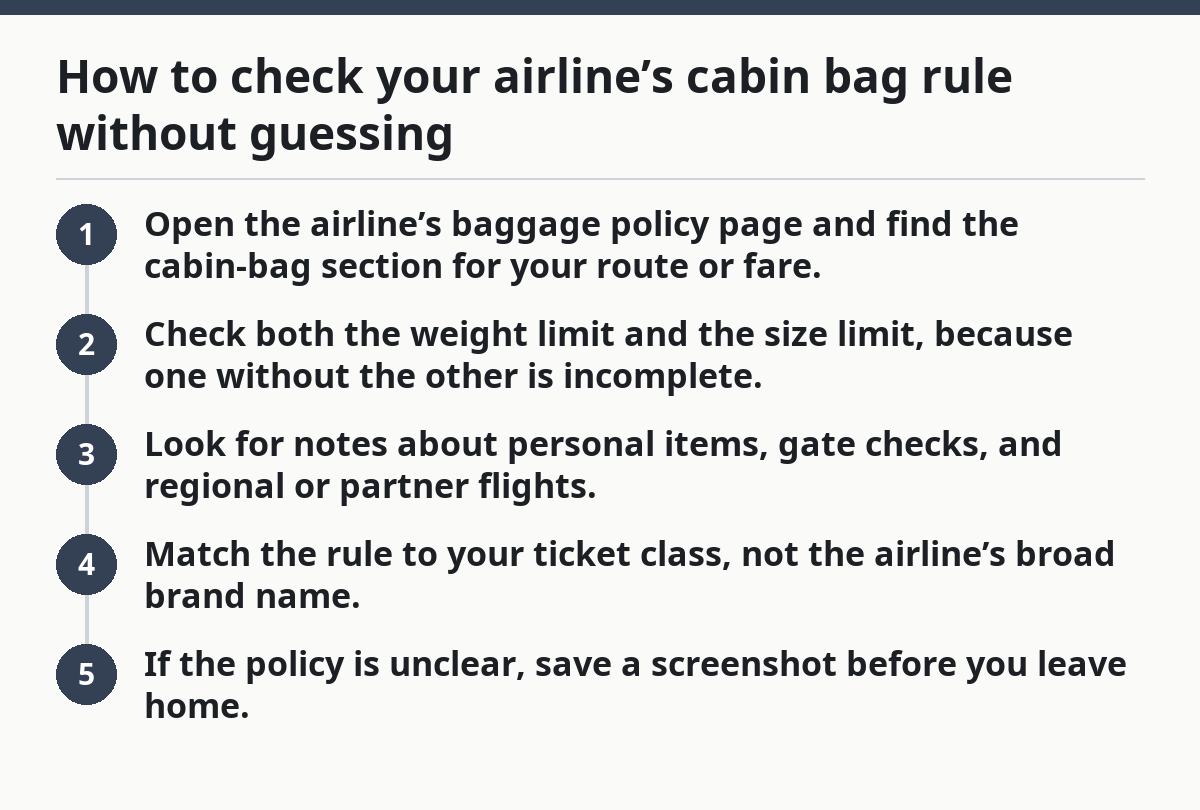
That last step sounds small, but it helps when a gate agent sees a different interpretation in the system. A screenshot with the date and flight number can save a lot of arguing.
Two reliable places to verify rules are the airline’s own baggage page and the airport or civil aviation authority’s passenger guidance page. For general packing standards, the International Air Transport Association’s passenger baggage guidance is a useful reference point, though it never replaces the airline’s own limit. The FAA’s Pack Safe page is helpful for item restrictions, not cabin-bag weight rules.
How do I weigh a packed carry-on before I leave?
Picture this: your bag is zipped, your shoes are inside, and the handle feels heavier than last time. Weigh it now, because an extra 1 kg can be the difference between boarding and repacking at the counter.
A digital luggage scale is the simplest tool for this job. It gives you a quick number without guessing, and it works better than bathroom scales for a packed bag. If you only have a bathroom scale, you can still get a rough reading, but it takes more steps and is easier to get wrong.
Follow this simple method:
- Hang the packed bag from the luggage scale handle and lift it fully off the floor.
- Wait for the number to settle for a second or two.
- Compare that number with the airline’s published limit.
- If you are within 0.5 kg, repack now instead of hoping for mercy later.
- Check the bag again after moving items, because small changes add up fast.
A packed bag should be weighed with everything inside it: laptop, charger, toiletries, headphones, and the jacket you plan to stuff into the top at the last minute. That jacket counts if it rides on the bag at the gate.
On the flip side, don’t weigh a nearly empty bag and assume you’re safe. A travel adapter, a power bank, and a pair of heavy shoes can push a light bag over the line faster than most people expect.
Mistakes that get people stopped at the gate
- Guessing the weight: costs time and may trigger a repack.
- Checking only size: costs you if the airline has a hard weight cap.
- Forgetting the personal item: costs you if the airline weighs both pieces together.
- Packing heavy items on top: costs you when the gate agent asks for a quick recheck.
Budget carriers vs full-service airlines: where the surprise usually is
Picture this: your ticket price looked friendly, but the cabin bag rule is the part that bites. That’s common with low-cost tickets, where the fare can be cheap and the baggage rules can be sharp.
Budget carriers are usually the strictest on weight, and that’s the main surprise for first-time flyers. They often make the cabin bag rule part of the fare design, so a light ticket can come with a tight 7 kg or similar cap. Some also charge for a larger overhead bag, or they separate the small under-seat item from the main cabin bag.
Full-service airlines can be different, but not always generous. Some publish a higher limit, others allow a cabin bag plus a personal item without stressing the exact scale number unless the bag looks oversized. Even then, a full-service carrier can still weigh luggage when the flight is full or when a regional aircraft has less bin space.
Here’s the practical difference:
- Budget carrier: expect a lower number and more checking.
- Full-service airline: expect more flexibility, but not a free pass.
- Regional aircraft: expect stricter handling regardless of airline brand.
- Busy holiday flights: expect more gate enforcement.
The useful part is that once you know the pattern, the fix is simple: pack lighter, move heavy items to checked baggage, or pick a fare that includes more cabin allowance. That is why a reader should think in airline type first, then in route, then in the exact fare.
One honest limit: this guide is not for anyone who wants a one-size-fits-all number. There isn’t one. A digital luggage scale and a checked look at the airline’s own rules beat memory every time.
Domestic airlines and international airlines are not the same
Picture this: you fly the same airline name on two different trips, but one is a domestic hop and the other crosses a border. The baggage policy may not match, even if the logo does.
Domestic and international routes can have different carry-on weight limits on the same airline. That happens because route length, aircraft type, partner flights, and local market rules can all change the policy. A domestic service may allow a lighter bag on a smaller plane, while an international long-haul ticket may include a more generous allowance.
This is where generic advice fails. A person who hears “full-service airlines are lenient” may still get surprised on a short domestic sector with a small overhead bin. A traveler who assumes “international means stricter” may be wrong on a long-haul fare that includes a bigger allowance.
Meanwhile, useful checks:
- Route: domestic, regional, or long-haul.
- Aircraft: smaller plane or wide-body jet.
- Fare family: basic economy, standard economy, premium.
- Partner flight: another airline may apply its own rule.
A real example of the type of difference you might see: one route can allow 7 kg while another on the same brand allows 10 kg or more. The point is not the exact number; the point is that the airline type plus route decides the rule.
If you fly often, keep a note in your phone for each airline you use most. Write the airline name, route, cabin, and the published cabin-bag limit. A 30-second note can save a much longer repack later.
What to do the night before you fly
Picture this: it’s the evening before departure, and your bag already feels full. That is the best time to catch a problem, because you still have a bed, a floor, and 10 minutes to fix it.
The night-before check should focus on weight, handle space, and the personal item. Don’t wait for the airport scales to tell you that a water bottle, charger block, or pair of jeans pushed you over the limit.
Do this in order:
- Put the packed bag on a digital luggage scale.
- Remove obvious heavy items if you are close to the limit.
- Move dense items to a checked bag if you have one.
- Keep documents, phone, charger, and one small snack in the easiest-to-reach pocket.
- Leave a little space in the bag so you’re not fighting the zip at the airport.
The best habit is to create a “fly kit” for the items you always carry: passport or ID, wallet, headphones, charger, prescription items, and a spare layer. That keeps the rest of the bag flexible.
If you are still over the limit after repacking, do not gamble on “maybe they won’t weigh it.” Budget carriers and busy flights are exactly where the scale gets used. A bag that is just under the limit at home is the one that gives you the least stress later.
Bottom line: the weight limit follows the airline type, but the ticket decides the final rule
Picture this: you know the airline type, the route, and the fare, and the number on the scale finally makes sense. That is the point of checking early, because carry-on weight limits are not random—they follow patterns you can predict if you look at the right details.
Budget carriers are usually the strictest. Full-service airlines usually give more room. Domestic and international routes can still change the rule on the same airline, and a gate agent will follow the published policy, not your best guess.
If you remember one move, make it this: weigh the packed bag at home, then compare it with the airline’s own baggage page. A digital luggage scale costs less than a last-minute baggage fee in time, stress, and repacking.
FAQ
Do airlines weigh carry-on bags?
Yes, many do, especially budget carriers and busy gates. Some airlines weigh every cabin bag, while others only check when a bag looks heavy or oversized. The real rule is the airline’s published policy for that flight, so the safest move is to assume your bag may be weighed.
What happens if my carry-on is overweight?
You may have to repack, pay a fee, or check the bag. The exact outcome depends on the airline, the route, and how far over the limit you are. A bag that is only slightly heavy is still a risk, because the gate agent may not have any flexibility.
How can I keep my carry-on under the limit?
Weigh it at home with a digital luggage scale, then move heavy items if you are close to the limit. Shoes, power bricks, and liquids add weight fast. If the bag is still close to the limit, check the airline’s baggage page again before you leave.
Drafted with AI; not yet reviewed by a person.





Leave a Reply