

Last updated: November 19, 2026
Pack your cruise carry-on as if your checked bag might miss the ship. The carry-on should hold your passport, medication, one outfit, swim gear, chargers, and a first-night kit. This article on How to Pack a Carry-On for a Cruise with Checked Luggage Backup gives you the day-one backup plan: what belongs in the bag, what stays in checked luggage, and what saves you if the suitcase shows up late. A cruise carry-on is not a general travel bag; it is your day-one survival kit.
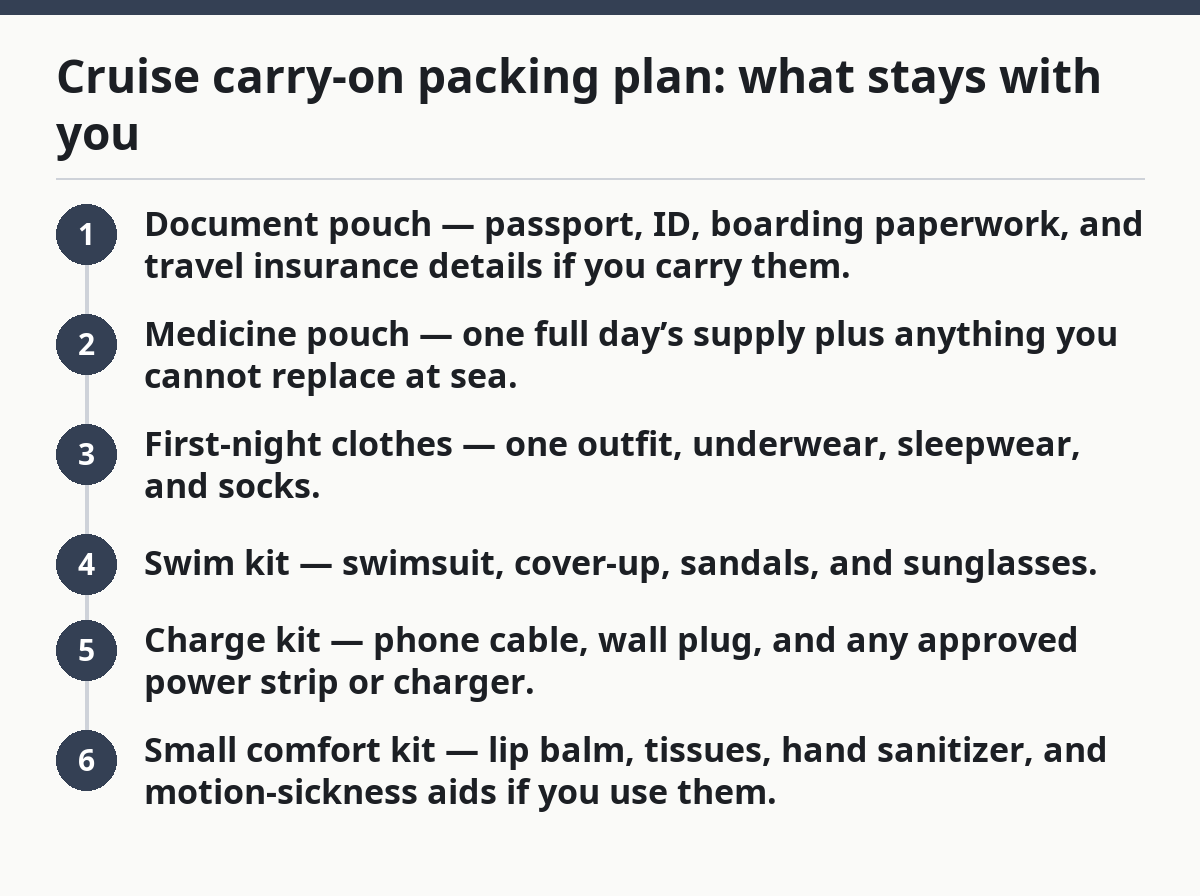
Cruise carry-on packing plan: what stays with you
Picture this: you’re at the terminal, your suitcase is gone to the hold, and you still need to board, pass security, and sleep tonight with what you packed in one bag. The carry-on is your insurance policy, and passport-first packing makes it work. A cruise carry-on is not a general travel bag; it is your day-one survival kit.
Start with the items you cannot replace easily on board. Put your passport or other required travel ID in an outside pocket or a slim document pouch. Add any medication you need the same day, glasses or contacts, a phone charger, and one change of clothes. If you have a prepaid embarkation check-in form, keep that with the documents too.
Then build for the first 24 hours, not the whole voyage. A swimsuit, cover-up, and flip-flops belong near the top because some ships let you hit the pool before your room is ready. A light layer helps on cold terminals and over-air-conditioned dining rooms. A pen matters more than people think, because cruise forms still turn up on paper.
Use this simple order:
- Document pouch — passport, ID, boarding paperwork, and travel insurance details if you carry them.
- Medicine pouch — one full day’s supply plus anything you cannot replace at sea.
- First-night clothes — one outfit, underwear, sleepwear, and socks.
- Swim kit — swimsuit, cover-up, sandals, and sunglasses.
- Charge kit — phone cable, wall plug, and any approved power strip or charger.
- Small comfort kit — lip balm, tissues, hand sanitizer, and motion-sickness aids if you use them.
For general carry-on sizing and packing habits on flights, the hub on carry-on luggage for air travel situations belongs nearby, but this cruise page stays focused on the ship side of the trip. The truth is, a cruise carry-on fails when it turns into a mini suitcase for every possible event. Keep it lean.
What do I pack if my checked bag arrives later?
Pack for one full day without your suitcase, because that is the real backup you need. Delayed luggage on a cruise is not the same as lost luggage on a flight; the ship may still get your checked bag later that day or the next port, but you cannot count on it for dinner, shore check-in, or bed.
The most useful backup loadout covers documents, medicine, a change of clothes, and toiletries. If your checked bag misses embarkation, you can still board, eat, sleep, and show up for the first sea day in decent shape. That is the goal.
A smart backup set usually includes:
- passport and boarding papers
- one or two prescription meds in original containers
- one clean outfit for daytime
- one outfit for dinner or a nicer venue
- underwear and sleepwear
- swimsuit and sandals
- toothbrush, toothpaste, deodorant, and a razor if you use one
- phone, charger, and earbuds
- glasses, contacts, and solution if needed
The catch is space. A carry-on gets crowded fast if you pack duplicate shoes or a second jacket “just in case.” That extra bulk costs you maneuverability in crowded terminals and makes it harder to find the one thing you need quickly. A 20- to 22-inch roller or a tote plus backpack split is usually easier than stuffing one soft bag to the seams.
If you want a rule that works, pack one spare of each category, not a second wardrobe. That keeps the backup useful and the bag closed.
How do I pack for embarkation day without overstuffing the bag?
Pack embarkation day items on top, because you may need them before your stateroom opens. The first hours are a strange mix of waiting, boarding, and wandering public spaces, so your carry-on should be easy to open and easy to live with in a crowded terminal.
Picture this: you’re rolling through check-in, your hands are full, and you need your ID, a charger, and sunglasses without unpacking the whole bag. That is why the layout matters. Put the things you need before lunch within the top layer, not buried under shoes or gifts.
Use a 3-zone setup:
- Bottom layer: less urgent items like a second outfit or backup toiletries
- Middle layer: clothing, swim gear, and folded layers
- Top layer: documents, medicine, charger, sunglasses, and anything you may need during boarding
A slim folder or zip pouch helps here, even if the rest of your bag is loose. Paper documents bend, disappear, and get wet easily. A waterproof sleeve or simple zip bag is enough.
A few embarkation-day items are easy to forget:
- boarding pass or cruise app login on your phone
- printed copies of required forms if the cruise line still asks for them
- a pen for customs or health paperwork
- snacks if your cruise line allows them
- motion-sickness tablets if you already know you need them
Now, you might be wondering about formal wear. If the sailing has a dress-up night, carry one wrinkle-resistant outfit in your checked bag and keep one less formal outfit in the carry-on. That way, you can still eat comfortably if the suitcase is late. A cruise starts the moment you board, not when the luggage cart catches up.
What should go in a cruise carry-on?
A cruise carry-on should hold the things that let you function for 24 hours: identity, medicine, clothes, swim gear, and chargers. That is the clean answer, and it keeps the bag from becoming a second checked suitcase.
Picture this: you’re on deck the first afternoon, and your checked bag has not shown up yet. If your carry-on is right, you can still change clothes, rinse off, charge your phone, and make dinner. That is the standard. Not even close to overpacking.
Here is the working list:
- passport or other required ID
- boarding documents and luggage claim stubs
- medication and a copy of prescriptions if you carry them
- one outfit for daytime
- one outfit for evening
- underwear, socks, and sleepwear
- swimsuit and cover-up
- sandals or pool shoes
- charger, cable, and adapter if needed
- toothbrush, toothpaste, deodorant, and face wash
- sunglasses, hat, and sunscreen
- a book, earbuds, or a small tablet
- motion-sickness aids if you use them
A hard-sided 20- to 22-inch carry-on gives structure, while a backpack makes the essentials easier to reach under a seat or under the terminal chair. The trade-off is real: a roller protects better, but a backpack wins when you need your hands free. If your bag is too full to close without a knee on it, you packed too much.
This is also where people make one classic mistake: they pack for “maybe.” Maybe the weather changes. Maybe there is a formal night. Maybe they want three pairs of shoes. That costs space and makes the carry-on useless as backup. Pack for the first day, not the whole itinerary.
Which first-night items matter most on a cruise?
First-night items matter because your checked bag may not reach your cabin until after boarding or dinner. Pack what turns a cramped arrival into an ordinary night: a clean shirt, sleepwear, toiletries, and anything you need before bed.
Picture this: you’re trying to shower after a long travel day and your toothbrush is somewhere on the luggage cart. That is the moment when a first-night kit pays for itself. Keep it in one pouch or one easy-to-spot cube, not scattered across the bag.
Your first-night kit should include:
- toothbrush and toothpaste
- deodorant
- face wash or wipes
- sleepwear
- underwear and socks
- a T-shirt or simple top
- medication for the evening and morning
- phone charger
- glasses or contacts
- earplugs if you sleep lightly
You can add a tiny laundry bag or plastic bag for damp swimwear. That keeps wet items from sitting against clothing. If you plan to shower before bed, a small bottle of shampoo or body wash helps too, though many cruise cabins stock basic toiletries.
The biggest mistake here is hiding all your hygiene items in the checked bag because “the cabin will have some basics.” That gamble can leave you buying replacements on board, where convenience matters more than selection. A first-night pouch weighs almost nothing and saves a lot of annoyance.
How do I use carry-on backup for sea days and shore days?
Use your carry-on backup to protect the first two cruise days, because sea days and shore excursions can expose every packing mistake at once. On a sea day, you may need sunscreen, a swimsuit, a book, and a light layer. On a shore day, you may need a charger, water bottle, and a spare shirt after an excursion.
Picture this: you’re stepping off the ship for a port visit, and your phone battery is already low. If your charger is in the carry-on and your backup clothes are sorted, the day stays easy. If those basics are buried, the whole plan slows down.
For sea days, keep these items easy to grab:
- swimsuit
- cover-up or shorts
- sandals
- sunscreen
- sunglasses
- hat
- book or e-reader
- refillable water bottle if allowed by the cruise line
For shore days, add:
- compact day bag
- portable charger if permitted
- copies of ID, not the originals, if you plan to leave the ship with one
- any excursion paperwork
- a dry shirt and small towel if your activity involves water
The smart move is to leave the carry-on packed as a backup, not unpacked into cabin drawers on day one. That way, if your checked luggage still hasn’t arrived, you are not rebuilding your travel life from scratch. A carry-on that can switch from boarding mode to sea-day mode in 30 seconds is doing the job.
One more warning: do not put every valuable item in checked luggage just because the cruise is “safe.” Shipboard bags move through crowded spaces, and late luggage is a common enough problem that the backup plan needs to stay in your hand. That is the whole point.
Cruise carry-on mistakes that cause the most trouble
Some of the worst cruise carry-on mistakes are easy to spot: packing the passport in checked luggage, forgetting medication, and treating the carry-on like a souvenir bag. Those errors cost you time, money, and comfort on day one.
Picture this: you’re at the port and the ship needs your documents now, not after your bag shows up. A missing passport or boarding form can turn a simple check-in into a long delay. The fix is simple: keep documents and medicine on your person or in the top pocket of the carry-on.
Common mistakes to avoid:
- Checking the passport: this can stop you at embarkation.
- Packing all medication in checked luggage: this leaves you exposed if the bag is delayed.
- Bringing too many shoes: this eats space fast and helps very little.
- Skipping a swimsuit: you may miss the pool or hot tub on day one.
- Forgetting a charger: dead phones make boarding, messaging, and photo use harder.
- Ignoring one spare outfit: a late bag feels much worse without it.
The truth is, a cruise carry-on works best when it is boring. It should not be stylishly stuffed, and it should not be stuffed with “nice to have” extras. If you can open it in a busy terminal and find your passport in under 5 seconds, you packed it right. If not, trim it again.
For official travel-document and medication questions, the cruise line’s own embarkation page and your national travel authority are the right places to check before you go. The CDC’s cruise travel guidance and your cruise line’s boarding rules are better sources than internet guesses.
Key takeaways
- Keep the carry-on focused on day-one survival, not the full cruise wardrobe.
- Put passport, medication, charger, and one clean outfit where you can reach them fast.
- Add swimsuit, sandals, and toiletries so a late checked bag does not ruin embarkation.
- Pack one spare of each need, not duplicate everything.
- Leave the bag organized for sea days and shore days so backup gear stays useful.
What should go in a cruise carry-on?
A cruise carry-on should hold your passport or other required ID, medication, a charger, one outfit, swim gear, and basic toiletries. Those items cover boarding, the first night, and the most common delays if your checked bag is late.
What do I pack if my checked bag arrives later?
Pack for 24 hours without it. That means documents, medicine, underwear, sleepwear, a daytime outfit, a dinner outfit, swimsuit gear, and toiletries you use every day.
Do I need different items for embarkation day?
Yes, because embarkation day is about access, not just storage. Keep documents, medication, a charger, and any boarding paperwork on top, then add swimwear and one easy outfit so you can change plans without opening the checked bag.
Drafted with AI; not yet reviewed by a person.




Leave a Reply