
Last updated: November 18, 2026
Quick answer: for Hardside Carry-On Luggage vs Softside for Durability, hardside is usually better against crushing and shell cracks, while softside usually does better against scuffs, stretches, and small tears.
This guide settles the trade-off between crack resistance, tear resistance, flexibility, and weight so you can pick the one that fits your trips.
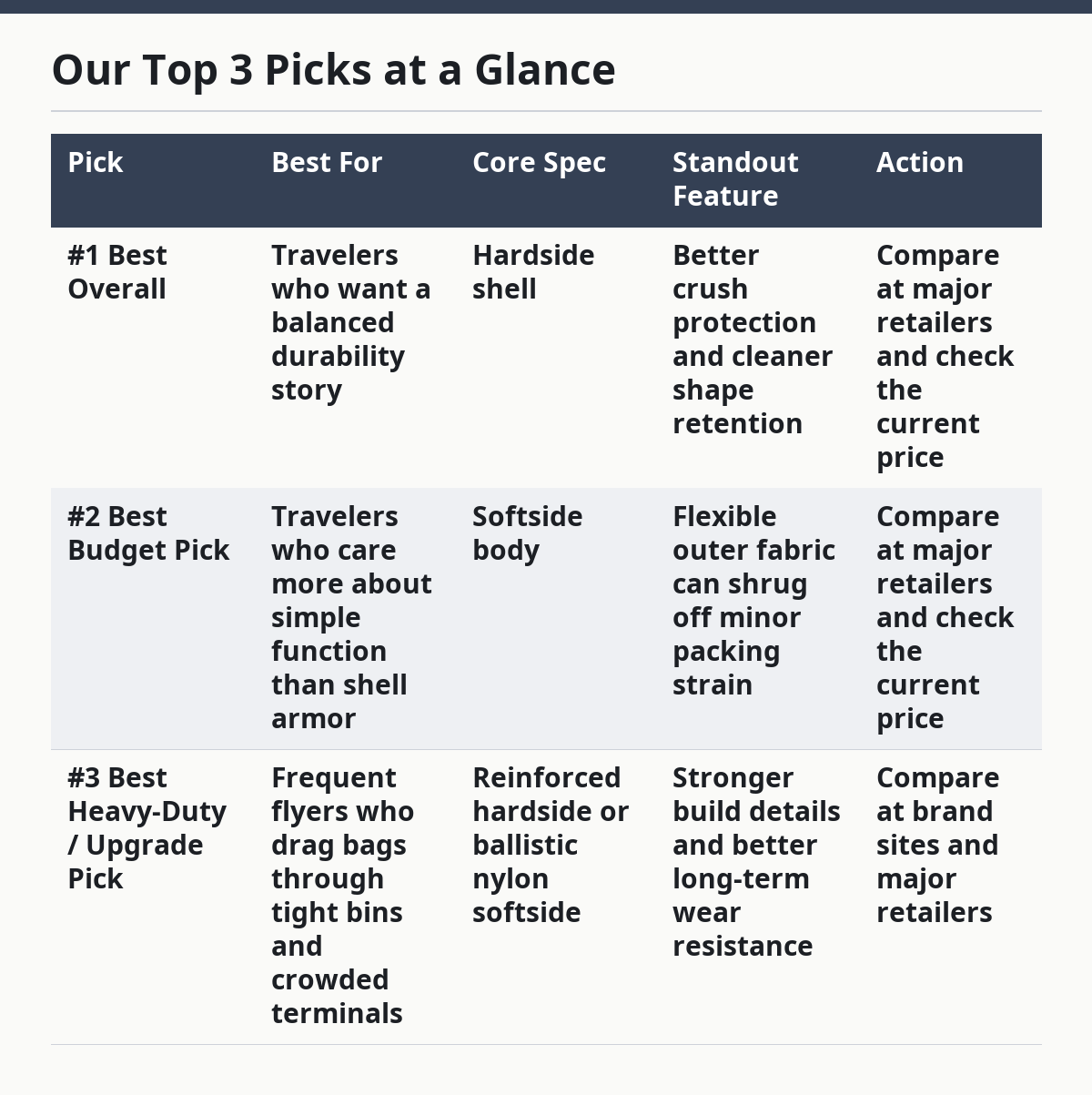
Our Top 3 Picks at a Glance
| Pick | Best For | Core Spec | Standout Feature | Action |
|---|---|---|---|---|
| #1 Best Overall | Travelers who want a balanced durability story | Hardside shell | Better crush protection and cleaner shape retention | Compare at major retailers and check the current price |
| #2 Best Budget Pick | Travelers who care more about simple function than shell armor | Softside body | Flexible outer fabric can shrug off minor packing strain | Compare at major retailers and check the current price |
| #3 Best Heavy-Duty / Upgrade Pick | Frequent flyers who drag bags through tight bins and crowded terminals | Reinforced hardside or ballistic nylon softside | Stronger build details and better long-term wear resistance | Compare at brand sites and major retailers |
This is not a style contest. It is a damage contest.
Key Takeaways
- Hardside is the safer bet if you worry about crushing, corner hits, and the bag losing shape.
- Softside usually wins when the bigger threat is rubbing, squeezing into overhead bins, or fabric wear.
- Polycarbonate hardside shells tend to flex better than brittle plastics, but any shell can crack if the hit is sharp enough.
- Ballistic nylon softside bags resist abrasion well, yet seams, zippers, and corners are still the weak points.
- If your trips involve rough baggage handling, the right answer may be a sturdier construction rather than the material alone.
I write luggage material guides for readers who want a bag that survives real travel, not a pretty shell on a product page.
Hardside vs softside: what durability really means
Hardside wins for shape protection; softside wins for forgivability. That sounds simple, but the real decision is about how a bag fails and what kind of failure you can live with.
Because of that, the first question is not which bag looks tougher. It is which kind of damage worries you more.
Picture this: you’re squeezing a carry-on into an overhead bin, then yanking it back out after someone has mashed a tote against it. A hardside case is more likely to keep its form. A softside case is more likely to bend, compress, and recover.
That difference matters because the two materials fail in different ways. A shell can crack. Fabric can tear. A rigid case can show fewer visible signs of wear and still be damaged at stress points. A fabric bag can look rough, yet keep working because the outer layer is flexible.
The main decision is not “which is tougher?” It is “which kind of damage worries you more?”
- If you hate dents, corner hits, and crushed contents, hardside is the better match.
- If you fear zipper strain, scuffed panels, and frayed edges, softside deserves a close look.
- If you want a bag that can be overstuffed a little, softside usually gives you more forgiveness.
For a broader material map, the hub on Luggage Materials and Durability sits above this page and covers the wider field.
Why hardside carry-on luggage wins on crush resistance
Hardside wins here because the shell spreads force better than fabric. That makes it the stronger choice for bag-pressure events, stacked bins, and the kind of hit that would crease a softer outer layer.
For example, if your case ends up under another suitcase in a crowded bin, or a gate agent drops it onto a curb, a rigid shell is built to protect the interior from direct impact and outside pressure. Polycarbonate shells are favored because they can flex more than brittle plastics, which helps in impact-heavy use.
The catch: a shell that flexes can still fail at the edges, zipper track, or handle mount. A hard case is not magic armor. If the impact is sharp enough, the shell can crack instead of tearing, and a crack is often a permanent problem.
A good hardside choice makes sense when:
- you pack electronics, glass bottles, or hard objects that need a firmer exterior
- you want the bag to keep its outline in the overhead bin
- you hate fabric snagging on rough surfaces
A hardside case is the wrong fit when you rely on external pockets, stuff the bag beyond its shape, or want easy expansion.
Why softside carry-on luggage wins on flexibility and small damage
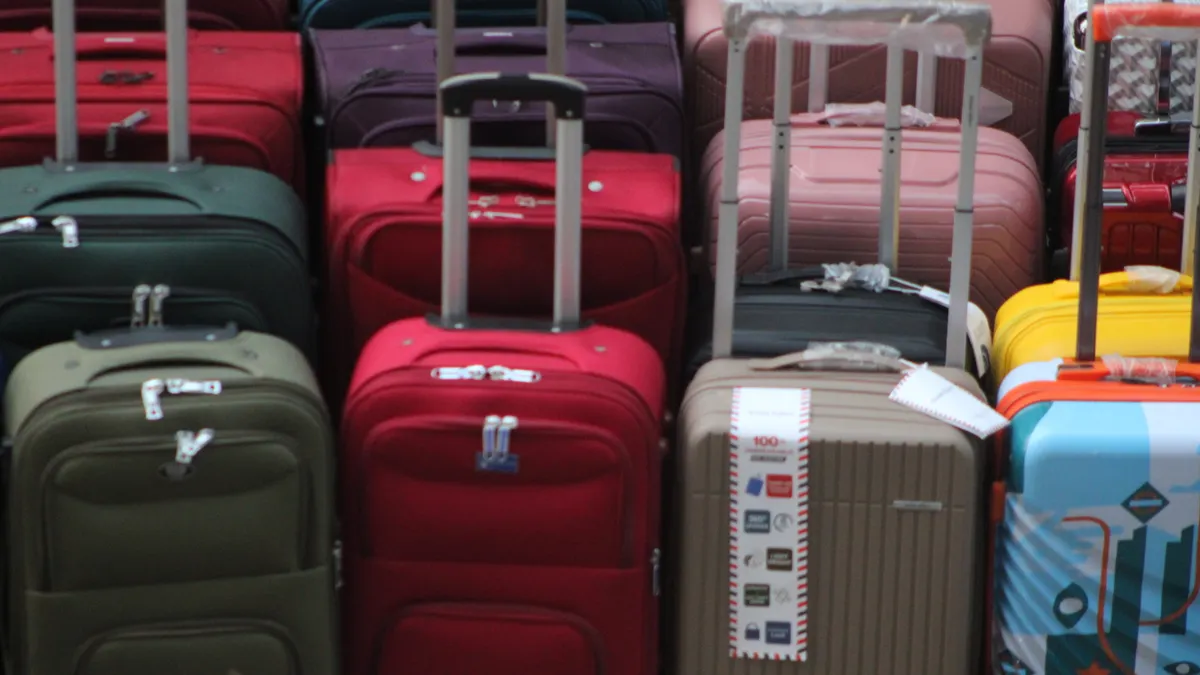
Softside wins when the fight is against friction, not impact. Fabric gives, shifts, and recovers, which helps in tight overhead spaces and with the constant minor abuse of travel.
For instance, when you are sliding the bag into a full bin and nudging it into place beside coats and backpacks, a softside case can compress a bit without stressing a rigid panel. That flexibility is useful on regional flights, commuter trips, and any route where every inch of bin space matters.
The strongest softside material in this lane is ballistic nylon, which is known for abrasion resistance. That does not mean it is indestructible. The weak spots are still the seams, corner piping, zipper areas, and handles. A cut near a seam is worse than a scuff on a shell because it can spread.
Softside is the better pick if you value:
- exterior pockets for chargers, documents, or a jacket
- a little extra packing stretch
- easier repair in some cases, since damaged fabric panels can sometimes be patched more readily than a cracked shell
Skip softside if your main fear is crushing or shell puncture. Fabric can resist rubbing well, but it gives less protection to hard contents when the bag takes a hard hit.
The honest side-by-side
Hardside is better for structure, while softside is better for flexibility. That is the simple answer, and the table below shows where the choice changes in real use.
| Criteria | Hardside | Softside | Winner for [condition] |
|---|---|---|---|
| Crush resistance | Stronger shell protection against pressure and stacking | More likely to compress under load | Hardside for crowded bins and stacked bags |
| Tear resistance | No fabric to tear, but shell can crack | Fabric can resist abrasion, yet seams can rip | Hardside for sharp external contact |
| Flexibility | Rigid shape, little give | Comes with more natural give and squeeze room | Softside for tight overhead bins |
| Impact failure mode | Can crack or split at stress points | Can fray, scuff, or puncture more gradually | Softside for damage that should stay usable longer |
| Weight tradeoff | Often heavier because of the shell | Often lighter for the same size class | Softside for weight-sensitive travelers |
| Shape retention | Holds shape well when packed | Can bulge if overpacked | Hardside for neat packing |
| Access on the move | Usually fewer outer-access features | Often includes exterior pockets | Softside for quick access items |
| Long-term cosmetic wear | Shows scuffs and scratches on the shell | Shows fraying and grime on fabric | Softside if you care more about visible scratches |
The truth is, the durable winner changes by damage type. Hardside wins the shell fight. Softside wins the squeeze fight.
Hardside luggage: who should actually buy it
Hardside is the better buy for travelers who need a cleaner shield around the contents. That is especially true if you fly often, pack fragile items, or dislike bags that lose their shape after a few trips.
For example, if you open the case and want the contents to look as organized as they did when you packed them, a rigid shell helps the inside stay put. It is also easier to wipe down when the outer surface gets dirty from airport floors, curb drops, or cargo dust.
The weaknesses are real. Hardside luggage can show cracks around high-stress points, and a split shell is a bigger problem than a scratched one. It is also less forgiving when you want to stuff in a sweater at the last minute.
A good hardside pick is for:
- travelers who want the best shot at protecting breakables
- people who value structure over pocket space
- flyers who are tired of soft bags getting crushed flat
Who Should Skip This: travelers who need quick-access pockets or who routinely overpack should look at softside luggage instead.
Buy this if: you pack electronics, toiletry bottles, or rigid items and want more crush protection.
Skip this if: you need expandability or exterior pockets for documents, chargers, or snacks.
Softside luggage: where it wins in real travel
Softside is the better buy for travelers who want flexibility, lighter feel, and fewer worries about scuffing a shell. It is the practical choice when your carry-on has to squeeze into odd spaces and still keep moving.
For instance, if you are on a short trip and the bag needs to move from car trunk to train shelf to overhead bin without much fuss, softside handles that kind of life well because the outer body gives instead of fighting every squeeze. A ballistic nylon model can take abrasion better than plain fabric, which matters when bags scrape against concrete, seat rails, and bin edges.
The weakness is that softside can look tired sooner if the corners take repeated abuse. Zippers and seams are the first places to watch. If those fail, the bag can still be usable, but the damage may spread. That is the price of flexibility.
Softside is the better fit for:
- travelers who use exterior pockets often
- people who want a lighter bag class
- anyone who values easy squeeze-in storage over a rigid shell
Who Should Skip This: travelers carrying fragile souvenirs or hard-shell cosmetics should consider hardside luggage instead.
Buy this if: you want lighter handling and extra packing flexibility for short or frequent trips.
Skip this if: your main worry is crushing or puncture damage.
When the verdict flips
Because hardside is not always the right answer, and softside is not always the smart compromise, a few real-world situations change the call fast.
For example, your route may change from smooth business travel to crowded connections, or from one checked-bag trip to many carry-on-only flights. The material choice can flip when the stress pattern changes.
Here are the cases where the overall verdict shifts:
- You pack fragile hard goods. Hardside wins because shell protection matters more than stretch.
- You need exterior access. Softside wins because pockets beat a sealed shell every time.
- You are weight-sensitive. Softside often has the edge, especially if every pound matters in a small cabin bag.
- You want shape stability. Hardside wins when you hate bulging sides and crooked packing.
There is one more flip point: if your real problem is build quality, not material, then neither label solves it by itself. A flimsy zipper, weak handle, or bad wheel mount can ruin either style.
The verdict: which one to choose and why
Choose hardside if you want better crush protection, cleaner shape retention, and a stronger shell around fragile items. Choose softside if you want more flexibility, lighter handling, and better access through exterior pockets. Neither if your real problem is a weak zipper, a bad handle, or a bargain bag built with thin parts.
That is the call. For pure durability against crushing and impact, hardside has the edge. For durability against abrasion, packing strain, and everyday squeeze-down use, softside can last longer in practice.
Because of that, the choice depends on what ruins your bag first. Shell cracks favor hardside. Fabric tears favor softside.
What this means for frequent travelers
Frequent use changes the wear pattern, so the better bag is the one that survives the kind of abuse you repeat. Hardside is usually the safer pick if your trips involve overhead-bin pressure, stacking, or hard contact with cargo edges. Softside is often smarter if your travel life means constant access, quick repacking, and lots of minor friction.
For instance, if you fly the same route month after month and the bag keeps meeting the same bin, the same curb, and the same grab point, repetition exposes the weak spot. A rigid shell can keep its shape, but stress points tend to show first; softside can absorb routine rubbing, but corners and seams still take the hit.
For frequent flyers, the useful rule is simple: use hardside for repeated compression and softside for repeated abrasion. In a 2024 world of crowded cabins and tight overhead bins, the material that fails last is the one that matches the damage you see most often.
Sources and related reading
For airline carry-on size limits, see the FAA guidance on carry-on baggage and IATA’s passenger baggage guidance. For material background, see polycarbonate and ballistic nylon.
Drafted with AI; not yet reviewed by a person.




Leave a Reply