

Last updated: November 19, 2026
Quick answer: 2 things decide whether Solar SPC Tech luggage is worth it—battery rules and usable charging. Solar SPC Tech luggage only makes sense if the solar panel is there to top up a removable power bank; it is a bad fit if you want a light, simple carry-on that never raises battery or repair questions. The real decision is not “solar or not” but whether the charging setup, battery rules, and suitcase weight actually help on your trips.
Key takeaways
- Solar luggage is useful only when the charging system is practical, removable, and allowed by the airline.
- The panel itself is not the whole product; the battery pack, wiring, and storage space matter more.
- If the bag is heavy, hard to repair, or unclear on battery rules, skip it.
- A plain carry-on plus a separate power bank is usually the safer choice for most travelers.
What is Solar SPC Tech luggage supposed to do?
Solar SPC Tech luggage is supposed to store power in a solar-equipped suitcase, then use that power for phones, tablets, or other small devices. In practice, the value depends on whether the solar part charges an internal system or a removable battery, because airline rules focus on lithium batteries, not branding.
That distinction matters because the TSA’s lithium battery guidance and the FAA’s advice on portable chargers both treat spare batteries as carry-on items, not checked-bag items; if you are unsure how your bag is configured, consult the TSA, the FAA, or your airline before flying. The most useful page to read is the TSA’s lithium batteries page and the FAA’s “Pack Safe” guidance on portable chargers: https://www.tsa.gov/travel/security-screening/whatcanibring/items/lithium-batteries and https://www.faa.gov/hazmat/packsafe.
A generic article often skips that point and treats “solar” like a free pass. It is not. The bag still has to work within airline battery rules, and the charging panel still has to be big enough to matter in real travel, which is hard to do on a small suitcase shell. If the listing is vague, consult the seller or a travel professional before buying.
How does solar luggage compare with a regular carry-on?
Solar SPC Tech luggage loses on simplicity and usually wins only on built-in charging convenience. A normal carry-on is lighter, easier to repair, and far less likely to create confusion at security or at the gate.
| Criteria | Solar SPC Tech luggage | Regular carry-on | Winner for [condition] |
|---|---|---|---|
| Battery handling | May include a built-in or removable power system | No battery system unless a separate charger is packed | Regular carry-on for fewer rules |
| Weight | Typically heavier because of panel and electronics | Usually lighter | Regular carry-on for overhead-bin ease |
| Repairability | Electronics can make repairs harder | Simple shell and wheels are easier to service | Regular carry-on for long-term use |
| Charging convenience | Built-in trickle charging can help in bright conditions | Needs a separate power bank | Solar SPC Tech for slow top-ups |
| Airline clarity | Battery rules can be a question mark unless clearly documented | Easy to understand | Regular carry-on for stress-free screening |
| Theft risk | Charging parts can attract attention | Plain luggage is less tempting | Regular carry-on for public transit |
| Weather exposure | Solar panel and ports need protection | Fewer exposed parts | Regular carry-on for rough handling |
| Best use case | Travelers who sit near daylight and want a backup charge | Most travelers, especially frequent flyers | Regular carry-on for most trips |
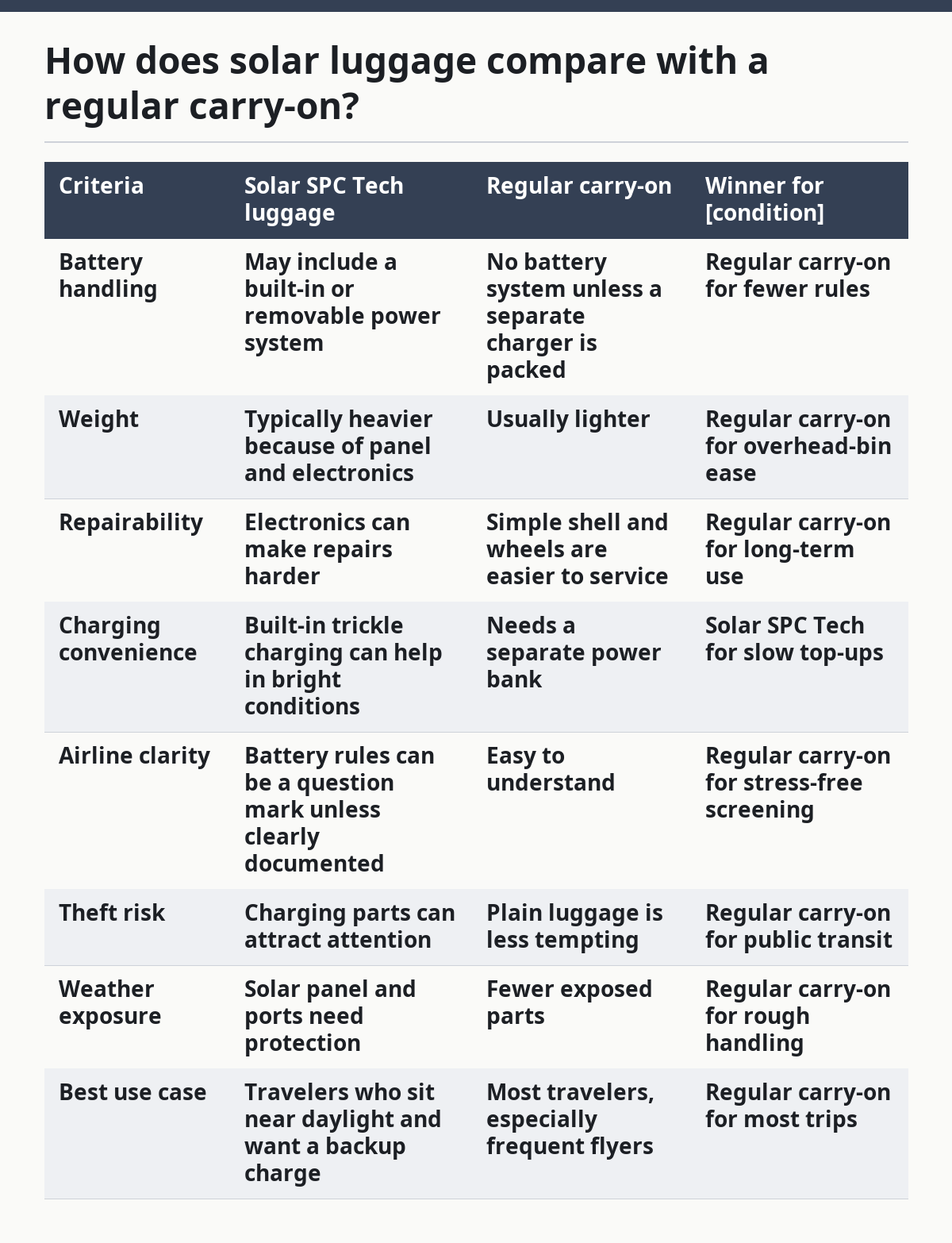
The key weakness of solar luggage is that the charging feature can sound better than it performs. A panel on a suitcase shell usually gets partial sun at best, and that means the suitcase is often acting like a charger that works slowly and unpredictably. The benefit is real only when the bag includes clear battery details and you travel in a setting where daylight exposure is common.
The regular carry-on wins for most people because it does one job well: it carries clothes and keeps the trip simple. If the reader’s real problem is choosing luggage for flight travel, a plain carry-on usually solves more problems than solar tech creates.
Who should actually buy Solar SPC Tech luggage?
Solar SPC Tech luggage is best for travelers who want a backup charge and are willing to accept extra weight, extra parts, and more rule-checking. That usually means light travelers, commuters, and people who spend time in outdoor or daylight-heavy settings where the panel might get repeated exposure.
It is also a better fit for someone who understands the battery label before buying. The bag should state whether the power system is removable, what battery type it uses, and whether the listing says anything about carry-on restrictions. If the product page does not explain those basics, that is a warning sign, not a mystery to solve later.
Because frequent flyers usually want the fastest path through security and the least chance of gate trouble, this option is not the best fit for that group. It is also a weak fit for travelers who pack near the carry-on limit, because even a modest electronics add-on can crowd out real storage. A suitcase that saves a phone charge but costs useful space is not a gain.
The honest draw is convenience in the right setting, not universal usefulness. Solar luggage is not a replacement for a power bank, and it is not a reason to ignore battery rules. If the only reason to buy it is the word “solar,” it is reasonable to skip it.
What should the listing tell you before you buy?
A good listing should tell you the battery setup, the panel type, the size of the bag, and where the product is sold. The absence of those facts is usually more useful than a long feature list, because unclear luggage creates headaches after checkout.
Look for these details before considering Solar SPC Tech luggage:
- Whether the power system is removable
- Whether the battery is lithium-based
- Whether the bag is meant for carry-on or checked use
- The exact shell size and wheel setup
- Whether the product is sold through more than one retailer, such as the brand site, Amazon, or Walmart
That last point matters because a single storefront is not enough for comparison shopping. A product that appears on more than one retailer gives the buyer a second place to check the current price, return rules, and listing details.
A good listing also avoids fuzzy language like “airport approved” unless it says what that means. Airline rules depend on battery type and carry-on status, not on marketing phrases. If the listing cannot say how the battery is handled, there is no reason to trust the rest of the pitch.
When does the choice flip?
The choice flips when the battery details are clear, the bag is used in daylight-heavy travel, and the buyer values charging convenience more than weight. In those cases, Solar SPC Tech luggage can be the better pick because the solar feature has a real job to do.
It also flips if the traveler already carries a laptop, phone, and headset and wants one extra source of backup power without packing a separate charging case. That is still not free benefit, because the suitcase becomes more complex, but the convenience can be enough for short trips.
The choice flips back the other way if the traveler often checks luggage, packs close to the weight limit, or wants a bag that can take a beating. Solar parts raise the number of things that can fail, and a broken wheel or failed port matters more than a panel that adds a little charge.
The biggest flip case is airline uncertainty. If the product page is vague about the battery, or if the user does not want to think about TSA and FAA battery rules, the smarter move is to buy a standard carry-on and a separate power bank. The solar feature is not worth extra stress if the rest of the trip is simple.
The verdict: which one should you choose?
Choose Solar SPC Tech luggage if you want a suitcase that can add backup charging and you are willing to verify battery details before you fly. Choose a regular carry-on if you want the lighter, safer, easier-to-understand option for most trips. Neither if the listing does not clearly explain the battery type, removability, and carry-on status.
That call is blunt for a reason. Most travelers do not need solar luggage, and the extra parts only earn their keep when the charging feature is truly useful. A clean, well-made carry-on still solves the bigger travel problem better for most people.
What if I mostly fly with carry-on luggage?
Then a regular carry-on is usually the better choice. A carry-on has fewer battery questions, fewer parts to break, and less weight to lift into the overhead bin. Solar luggage only starts to make sense if you really want built-in charging and are fine checking the airline rules first.
Is solar luggage actually allowed on planes?
It can be, but the battery rules matter more than the solar panel itself. The TSA and FAA guidance focuses on lithium batteries and portable chargers, which are usually meant to stay in carry-on bags rather than checked luggage. If the listing does not explain the battery clearly, do not assume it is travel-ready.
Does the solar panel make charging fast?
No, not in the way most people hope. A suitcase panel is exposed to changing angles, shade, and indoor storage, so it is better thought of as a slow top-up feature. For daily phone charging, a separate power bank is usually more predictable.
Who should skip Solar SPC Tech luggage?
Anyone who wants the lightest possible carry-on, the simplest airport experience, or the fewest repair worries should skip it. It is also a poor choice if the product page is vague about battery details or if the bag will spend most of its life indoors. In those cases, the solar feature adds more noise than value.
Drafted with AI; not yet reviewed by a person.



Leave a Reply