
Last updated: November 19, 2026
Key Takeaways
- Airlines usually separate this from the overhead-bin carry-on, and that split often causes confusion.
- A personal item is a smaller bag that stays under the seat, not in the overhead bin.
- Airline personal item limits are usually written as three dimensions, such as height, width, and depth, and the bag has to stay within those limits when packed.
- A backpack often works well when you want a bag that can flex under the seat without wasting space.
Your personal item has to fit the airline’s under-seat space, not just sound “small enough.” For Carry-On Personal Item Size Rules for Under-Seat Bags, the size rule is airline-specific, and the bag has to match both the listed dimensions and the seat space on your flight. The sections below sort out what that means in real use.
The one rule that matters for under-seat bags
A personal item must fit under the seat in front of you and still leave room for your feet, which is why the listed size matters more than the bag’s marketing label. Airlines usually separate this from the overhead-bin carry-on, and that split is where most confusion starts.
Picture this: you’re at the gate with a backpack that looks compact on the floor, then the agent asks for the size check and the bag is close but not quite right. That’s the problem this page solves. The shape, not just the volume, decides the fit.
Before you pack, compare the airline’s published personal item limit with the bag’s outside dimensions.
- If the bag is soft-sided, it can flex a little.
- If it is rigid, every inch counts.
- If it has a long handle, wheels, or thick side pockets, those can tip it over the limit.
The truth is, under-seat space is not one fixed standard across all planes. A bag that works on one aircraft can jam your knees on another.
What counts as a personal item?
A personal item is a smaller bag that stays under the seat, not in the overhead bin. For most travelers, that means a backpack, tote bag, briefcase, laptop bag, or small duffel bag that meets the airline’s posted limit.
The label on the bag matters less than the fit. A tote with a wide open top can be a personal item if it is small enough. A compact duffel can also work if it does not bulge into a boxy shape. A bulky travel bag with a slim-looking body may still fail if the seams, handles, and outer pockets push it past the limit.
Here’s the catch: airlines do not all define the term the same way. One carrier may allow a larger under-seat bag than another, and some are stricter about “must fit completely under the seat” than others.
- Common personal item types:
- backpack
- tote bag
- laptop bag
- briefcase
- small duffel bag
- Common parts that cause trouble:
- tall handles
- stiff frames
- hard laptop sleeves
- oversized exterior pockets
The best way to think about it is simple: if the bag needs to be forced under the seat, it is already too big.
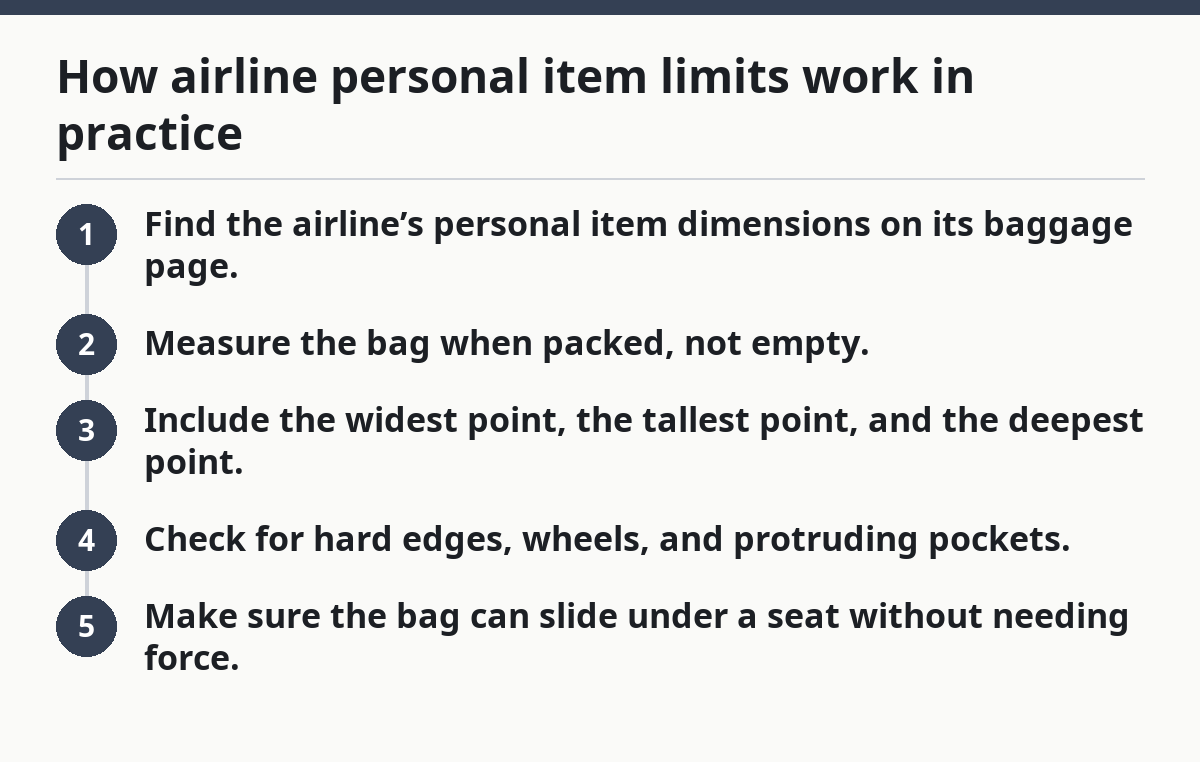
How airline personal item limits work in practice
Airline personal item limits are usually written as three dimensions, such as height, width, and depth, and the bag has to stay within those limits when packed. Some airlines measure in inches, others in centimeters, but the rule is the same: the bag must fit the published box and the under-seat space.
Picture this: you found a backpack that fits the airline chart, but it is stuffed full and sits lumpy across the top. That bag can still fail, because packed shape matters as much as the listed dimensions. A soft bag can help, but only to a point.
The practical way to read the rule is this:
- Find the airline’s personal item dimensions on its baggage page.
- Measure the bag when packed, not empty.
- Include the widest point, the tallest point, and the deepest point.
- Check for hard edges, wheels, and protruding pockets.
- Make sure the bag can slide under a seat without needing force.
Different airlines also enforce the rule differently. Some look only at the bag at the gate. Others care more if boarding is full and under-seat space is tight. That is why a bag that “usually works” can still be called out on a busy route.
The Airline Passenger Experience Association, or APEX, tracks airline experience standards and is a useful place to understand how carriers think about the passenger cabin. For baggage rules, though, the carrier’s own page is the source that matters.
Which bag shapes usually work best?
A backpack usually works best when you want a bag that can flex under the seat without wasting space. A tote bag works well when the load is light and flat. A small duffel bag can fit, but its round shape can waste depth if it is overpacked.
Picture this: you are trying to slide the bag under the seat while keeping your laptop, water bottle, and charger accessible. A soft backpack usually clears that hurdle more cleanly than a rigid tote with a stiff base. That is why shape often beats style.
Think in terms of the bag’s footprint:
- Backpack: good for even weight and a narrow profile.
- Tote bag: good for flat items and fast access, but it can tip open.
- Duffel bag: good for soft contents, but it can balloon at the sides.
- Rigid travel bag: usually the hardest to fit under-seat.
A backpack can be the safer choice if the airline is strict and the seat space is small. A tote can work if you pack it lightly and keep the top from spreading. A duffel is best when the bag has a structured bottom but soft walls.
You do not need the biggest bag you can find. You need the one that keeps its shape while staying narrow enough to slide in one clean motion.
How to measure your bag before you fly
Measure the bag at its widest, tallest, and deepest points, then compare those numbers to the airline’s personal item limit. Do not measure only the main compartment and ignore the extras, because that is where many bags go wrong.
Picture this: you are standing at home with a tape measure, trying to decide if your backpack will pass at the gate. This is the moment to check the real outside size, not the tag, not the product page headline, and not the empty-bag feel.
Use a soft measuring tape or a rigid ruler and follow the bag’s outer shell, not the inner storage space.
- Measure height from base to highest fixed point.
- Measure width across the broadest side.
- Measure depth from front panel to back panel.
- Include wheels, feet, and side pockets if they stick out.
- Repeat with the bag packed the way you plan to travel.
That last step matters. A backpack that looks fine empty can grow several inches once you add a laptop, charger, shoes, and a jacket. If the loaded bag is too tall or too deep, it may not fit even if the brand calls it a “personal item.”
A simple test helps: place the packed bag beside a chair or under a desk. If it barely clears that space, it may be too bulky for an under-seat slot on a full flight.
What airlines usually get strict about at the gate
Airlines usually get strict about bags that look overstuffed, have rigid edges, or clearly block the under-seat area. The personal item rule is most likely to be enforced when the cabin is full and every inch of floor space matters.
Picture this: you board early, but the flight is packed and the aisle is already tight. A bag that looked fine at home now has to disappear under a seat without spilling into the footwell. Gate agents notice that quickly.
The most common trouble spots are easy to spot:
- bags with hard shells or stiff frames
- backpacks with thick front pockets
- totes that spread wide at the top
- duffels that sag low and wide
- bags with wheels or long handles
A bag can also fail if it looks larger than the policy even when it technically squeezes in. That is why a soft-sided backpack often causes fewer problems than a boxy tote with a hard bottom.
On the flip side, under-packing can help a lot. If the bag is half full, it is easier to shape it to the space. A full personal item is much less forgiving than one with room to compress.
How to choose the right backpack, tote, or duffel
Choose the bag that matches your packing style and the airline’s size limit, not the bag that just looks most useful on a shelf. The wrong shape can turn a legal personal item into a gate-side problem.
Picture this: you travel with a laptop, cables, snacks, and a book, and you want them all within reach. A backpack usually handles that mix better than a stiff tote because it spreads the load and stays more stable under the seat.
Use these quick fit clues:
- Backpack: best for commuters, students, and anyone carrying a laptop.
- Tote bag: best for light packers who want fast access.
- Duffel bag: best for soft clothes and flexible packing.
- Avoid a bag that is designed for the overhead bin but claimed as a personal item.
A tote bag can be a smart choice if it has enough structure to stand up, but not so much that it turns boxy. A duffel bag works if the zipper closes without strain. A backpack is still the most reliable option when you do not know how crowded the cabin will be.
The trade-off is simple: more structure often means less flexibility. More flexibility often means less protection for fragile items. Pick the middle ground that fits your trip.
The easiest way to stay within the rule
The easiest way to stay within the rule is to pack the personal item first, then measure the packed bag and trim it down if needed. That keeps you from guessing at the airport, where the only number that matters is the one on the bag in front of the agent.
Picture this: you have one last decision before leaving home — which bag goes with you under the seat. Use the airline’s own limit, the bag’s outer dimensions, and the bag shape to make that call.
A simple packing order helps:
- Put the heaviest items flat against the back panel.
- Keep soft clothes around the edges.
- Leave hard items away from the outer walls.
- Close the bag and check for bulges.
- Test the bag in a chair or footwell-sized space.
- Remove one item if the bag looks tight or stiff.
This keeps the bag low and compact. It also helps you spot the one item that turns a neat personal item into an awkward lump.
If you want the larger picture, the hub on carry-on size rules and fit covers the main cabin-bag rules that sit around this page’s topic.
Common mistakes that cause personal item problems
The biggest mistake is assuming a “personal item” label means every airline will accept it. That mistake can cost you gate checks, repacking, or a last-minute reshuffle of your laptop and charger at the boarding area.
Picture this: you bought a bag online because the listing said “airline friendly,” but no one checked the actual dimensions against the carrier’s policy. The bag may be fine on one airline and wrong on another.
Watch for these errors:
- buying by volume instead of outside measurements
- ignoring wheels, feet, or handles
- packing the bag so full it no longer flexes
- using a tote that opens too wide
- assuming every under-seat space is the same size
The fix is boring but effective: measure the bag, compare it with the airline’s rule, and pack it with the under-seat slot in mind. A bag that works on a desk does not always work under a seat.
The truth is, under-seat bags reward restraint. Small, soft, and flat usually wins.
Frequently asked questions
What counts as a personal item?
A personal item is a smaller bag that fits under the seat in front of you. That usually means a backpack, tote bag, laptop bag, briefcase, or small duffel bag, as long as it meets the airline’s size rule and does not block foot space.
Do personal item size limits vary by airline?
Yes, personal item size limits vary by airline. Each carrier sets its own dimensions, and some are much stricter about under-seat fit than others. The safest move is to check the airline’s baggage page before you pack and measure the bag when it is fully loaded.
Can a backpack be a personal item?
Yes, a backpack can be a personal item if it fits the airline’s under-seat limit. Soft-sided backpacks often work better than rigid bags because they flex a little, but a stuffed backpack can still fail if it is too tall, too deep, or too bulky.
Drafted with AI; not yet reviewed by a person.



Leave a Reply