
Last updated: November 19, 2026
Quick Answer: measure the full outside shell of your carry-on suitcase with wheels and handles, including wheels, handles, feet, and any expanded section. If you want the number that matters at an airline size check, use the outermost point to outermost point, not the inside space.
If your carry-on suitcase with wheels and handles has to fit an airline size check, measure the full outside shell, wheels, top handle, side handle, and any expanded section. This guide shows how to measure a carry-on with wheels and handles so you don’t confuse interior space with the bag’s real footprint. It also clears up the mistakes that make a bag look smaller than it is.
Key Takeaways
- Measure the bag from the furthest outer point to the furthest outer point.
- Include wheels, handles, feet, and any bulging expansion zipper panel.
- Use a flat floor, a hard wall, and a measuring tape for the cleanest result.
- Measure the bag packed, closed, and fully zipped if you want the travel size you’ll actually carry.
- Don’t use the interior liner size, frame size, or brand label as your final number.
Measure the bag the airline actually sees
The answer is to measure the outside of the carry-on suitcase, not the inside, and to include the parts that stick out: wheels, top handle, side handle, and any expanded section. That outer measurement is the one that matters when a bag has to slide into a size checker.
Picture this: you’re standing in your hallway with a measuring tape and a hard floor, trying to find the real size of a carry-on before a trip. The shape looks simple until the wheels, grip, and pull handle push the total size past what the tag suggests.
A carry-on suitcase is judged by its full exterior footprint. That means the shell, the base, the wheel housings, the top grab handle, the side handle, and the expansion zipper if it adds depth. If any part sticks out, it counts in the final number.
Use the bag in the condition you plan to travel with. A half-empty case can measure smaller than it will when packed, and an expansion panel can add a surprising amount of depth. The safe rule is plain: measure the bag closed, zipped, upright, and packed the way you travel.
Now, you might be wondering why a brand label or model page is not enough. Because the same style can measure a little differently once the wheels, handle mounts, or expansion gusset are added. A listing that says “carry-on” is not a measurement. It is only a label.
How do you measure a carry-on suitcase with wheels and handles?
You measure it by checking height, width, and depth from the outermost points, then adding any handle or wheel that extends beyond the shell. That gives you the true carry-on suitcase dimensions.
Picture this: you have the bag beside a wall, and you need one clean set of numbers before you book a flight. The job is simple when you treat each axis one at a time and measure the bag’s farthest point. If the shape is hard to judge, a luggage shop or travel professional can help verify the result. Travel guidance from the U.S. Department of Transportation also reminds travelers that airlines set their own baggage rules, so checking the exact limits matters. U.S. Department of Transportation baggage guidance.
Start with the bag standing upright on a flat floor. The shell may look square, but the wheels and feet usually make the height taller than the case body. On some spinner bags, the wheel system adds the most height; on some two-wheel bags, the rear wheel housing does.
Then check width across the front face. Hold the tape at the farthest left edge and stretch it to the farthest right edge, including any side bulge from pockets or rigid trim. The point is not to measure the panel in the middle. The point is to measure the widest part of the exterior.
Finish with depth from front to back. This is where the expansion zipper matters most, because a zip-out panel can change a slim bag into a thicker one. If the bag has a top handle dome or a rear trolley rail bump, include that too.
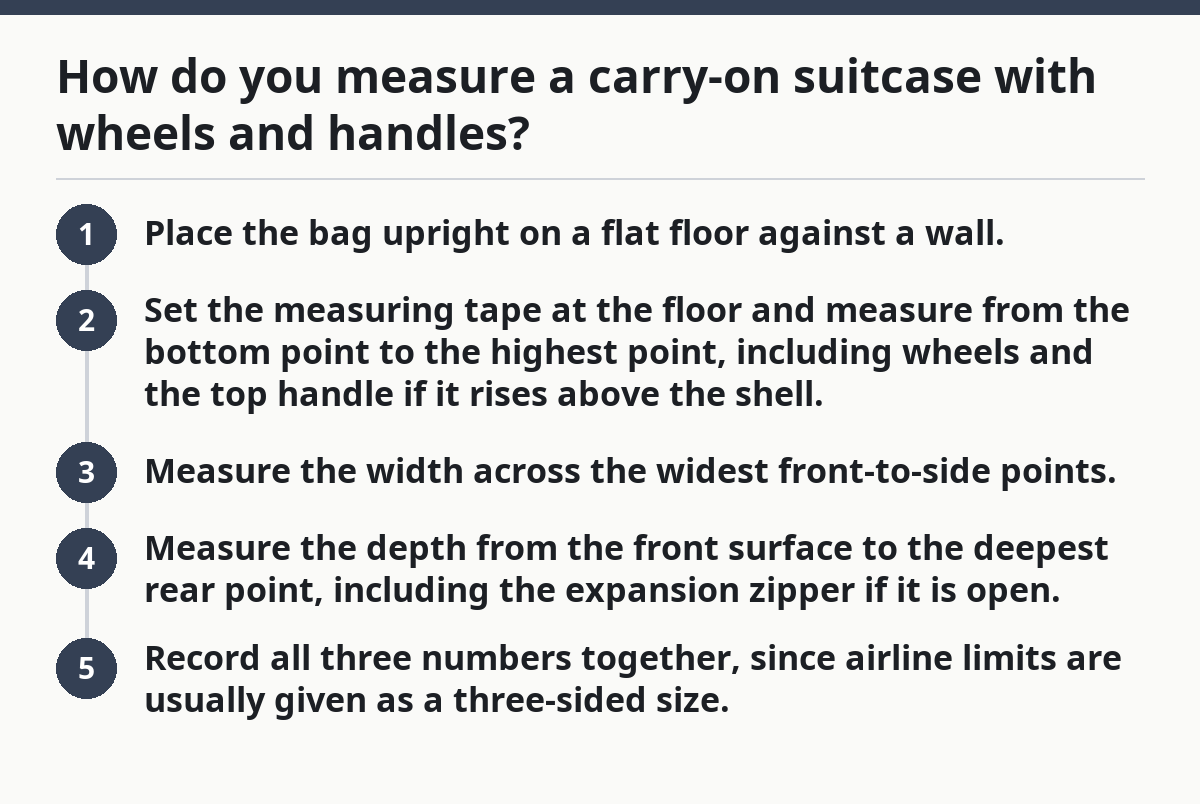
- Place the bag upright on a flat floor against a wall.
- Set the measuring tape at the floor and measure from the bottom point to the highest point, including wheels and the top handle if it rises above the shell.
- Measure the width across the widest front-to-side points.
- Measure the depth from the front surface to the deepest rear point, including the expansion zipper if it is open.
- Record all three numbers together, since airline limits are usually given as a three-sided size.
A bag can be within one dimension and still fail on another. That is why a single number is not enough. You need the full set.
Which parts count: wheels, handles, and expansion zipper?
Yes — wheels and handles count if they extend beyond the suitcase body, and the expansion zipper counts when it adds depth. Anything that changes the outside size is part of the carry-on measurement.
Picture this: you’re looking at a soft-sided carry-on with a zippered expansion panel and a pull handle tucked away. The main shell looks airline-friendly, but the corners, grip, and wheel base all add real inches once the bag is standing upright.
The easiest mistake is to treat the main fabric panel as the size of the bag. That misses the hardware. Wheel housings can add height. A top carry handle can rise above the shell. A side handle can add width or depth depending on where it sits. A telescoping trolley handle usually doesn’t count when it is collapsed inside the bag profile, but any exposed top housing or mounting point still can. If the bag is unusual or heavily built, check the airline’s rule sheet or ask a travel professional before you fly.
The expansion zipper needs special care. If the bag is packed at maximum expansion, measure it that way. If you travel with the zipper closed, measure it closed. Do not mix the two. A bag that is 22 inches tall when packed flat can become a larger bag once the expansion section is opened.
Here’s the catch: many readers measure the body and forget the hardware because it feels small. Those little pieces are exactly what pushes a bag into a size checker. A 1-inch mistake can be the difference between a bag that slides in and one that gets flagged.
- Wheels: count them when they stick below the base.
- Top handle: count it if it sits above the highest point of the shell.
- Side handle: count any handle that sits outside the body line.
- Expansion zipper: count the added depth only if you plan to travel with it open.
- Feet and bumpers: count them if they are part of the farthest outer edge.
What tools give the cleanest measurement?
A measuring tape, a flat floor, and a hard wall give the cleanest carry-on measurement. A soft ruler, a curved couch arm, or a thick carpet can throw off the result.
Picture this: you’re trying to get a number fast before a trip, and the bag keeps tipping or leaning. That small wobble changes where the tape starts and where it ends, which is why the setup matters as much as the tape itself.
A cloth measuring tape works well because it bends around the handle and wheel area without fighting the shape. A metal tape can also work if you keep it straight. Use a pencil and paper, or the notes app on your phone, so you write down height, width, and depth separately.
A hard wall helps you find the true back edge. Set one side of the bag against the wall, then measure from that fixed point instead of trying to hold the tape in midair. If the bag has soft sides, press only lightly; crushing the fabric changes the number.
For a packed bag, measure after it is fully zipped and standing as it will travel. If you use packing cubes or a jacket stuffed in the outer pocket, leave them in place. That is the real travel shape, and that is the shape that matters.
If you need a second reference, compare your number with the hub on carry-on size rules and fit so you can see how the bag’s outer size matches airline limits. This page is about the measuring method; the hub covers the wider rule set.
- Measuring tape: best for the bag’s full outer size.
- Rigid wall: best for a fixed starting edge.
- Flat floor: best for keeping the bag upright and square.
- Notebook or phone notes: best for tracking all three dimensions.
Common measuring mistakes that ruin a fit check
The biggest mistake is measuring the interior capacity instead of the outside size. That gives a fake sense of safety and tells you almost nothing about airline fit.
Picture this: you open the bag and measure the lining from seam to seam, then feel confident because the number looks generous. The problem is that airlines do not care how much fits inside the bag; they care how much space the bag takes up from the outside.
Another common error is measuring a soft bag while it is sagging on the floor. That can shrink the number. Stand it upright and square it up first. If the bag is leaning, the height may look shorter than it really is, and the width may spread wider than the actual frame.
People also forget the wheel base. On many spinner models, the wheels add more than they seem to. The same goes for a top handle that sits on a molded bump. Those parts may look like accessories, but they are part of the bag’s outer envelope.
A final mistake is measuring an expandable case only in its closed state, then packing it open. That is how a bag that looked fine at home turns into a problem at the gate. If the zipper will be open during travel, the open size is the one to record.
Do this instead:
- Measure the outside only.
- Keep the bag upright.
- Include wheels and handles.
- Measure the bag in the same packed state you’ll travel with.
- Write down the numbers before you forget them.
A quick way to check a carry-on before you leave
A quick check is to measure the bag in one pass, then compare the result to the airline’s carry-on allowance before you pack your passport. That usually takes only a few minutes and can save a gate check.
Picture this: you’re about to zip the suitcase shut for a morning flight, and you want to know if it is worth opening again. A quick three-step check catches the problem early, before the bag gets buried under clothes and chargers.
Measure height, width, and depth in the exact packed state you plan to travel with. If the bag has an expansion zipper, decide now whether it will stay closed. If the wheels or top handle sit outside the case line, include them every time. That gives you a usable number, not a guess.
This quick check is especially useful for soft-sided bags. They can compress a little at home and puff up once they are full. Hard-sided bags are more fixed, but they still vary at the handles and wheels. The bag’s shell is not the whole story.
If the numbers are close to the airline limit, give yourself some margin. Don’t trust a bag that only fits when it is empty or lightly packed. A carry-on that clears by a fraction at home can still be awkward once the zipper is forced shut.
Once you measure one bag properly, every future bag gets easier. The method stays the same.
How do you measure a carry-on suitcase with wheels and handles?
You measure it by taking the full outside height, width, and depth, including wheels, handles, and any open expansion panel. That is the number that tells you how the suitcase will actually fit in a size checker.
Picture this: you’ve got the bag in front of you and the tape in hand, but the corners are rounded and the handle keeps getting in the way. That is normal. The trick is to measure the farthest points, not the prettiest panel.
If the suitcase has wheels, start from the lowest point on the floor to the highest point on the bag. If the carry handle sticks above the shell, include it in the height. If the pull handle housing rises above the case when collapsed, include that too. Measure width across the widest side-to-side span. Measure depth from front to back, then repeat with the expansion zipper open if that is how you’ll travel.
Do not round down because a number looks close enough. A bag is either within the limit or it is not. That small difference matters most when the airline uses a rigid sizer frame.
For a second check, compare your note with a standard bag label only after you have your own measurements. A brand’s listed size can be helpful, but it is not the last word. The tape in your hand is the last word.
Do wheels count in carry-on measurements?
Yes, wheels count if they extend beyond the suitcase body. That is why a carry-on with wheels can measure taller than the shell alone suggests.
A lot of bags fail because the wheel base adds extra height at the bottom. The same can happen with wheel housings on spinner bags. Measure from the floor to the highest outer point, and the wheels will already be included.
Do handles count when measuring luggage?
Yes, handles count when they change the outer size of the bag. A top handle, side handle, or exposed pull handle housing can all affect the final measurement.
A collapsed telescoping handle may sit inside the bag’s profile, but the mount or dome above it can still add height. Measure the highest or widest outer point, not the flat panel below it. That gives you the real carry-on suitcase dimensions.
How do I measure an expandable suitcase accurately?
Measure the suitcase in the state you will actually use on travel day. If the expansion zipper stays closed, measure it closed. If you plan to open it, measure it open.
The depth changes most with expansion, so that is the number to watch. Use a measuring tape on a flat floor, write down the closed and open depths if needed, and keep the more honest number for the trip.
Drafted with AI; not yet reviewed by a person.




Leave a Reply