
Last updated: November 18, 2026
In short: reinforced-corner carry-on luggage is a smart pick if your bag gets hit at door frames, baggage bins, and curbside drops, and a hard shell carry-on with visible corner bumpers, spinner wheels, and a bag structure that keeps the corners from taking the full shock is often a strong option.
Key Takeaways
- Reinforced corners protect the impact zones that take the first hit when a bag drops, slides, or gets shoved into a bin.
- A hard shell carry-on often offers strong corner protection because the shell carries more of the load than fabric or trim.
- Reinforced corners work best when the bag structure supports them from the inside.
- Reinforced corners can be worth extra attention for travelers who move fast, pack full, and hate cosmetic damage.
If you want the quick answer before you spend, the comparison below helps settle which type of carry-on suitcase fits your trip, your packing style, and how much corner protection you actually need.
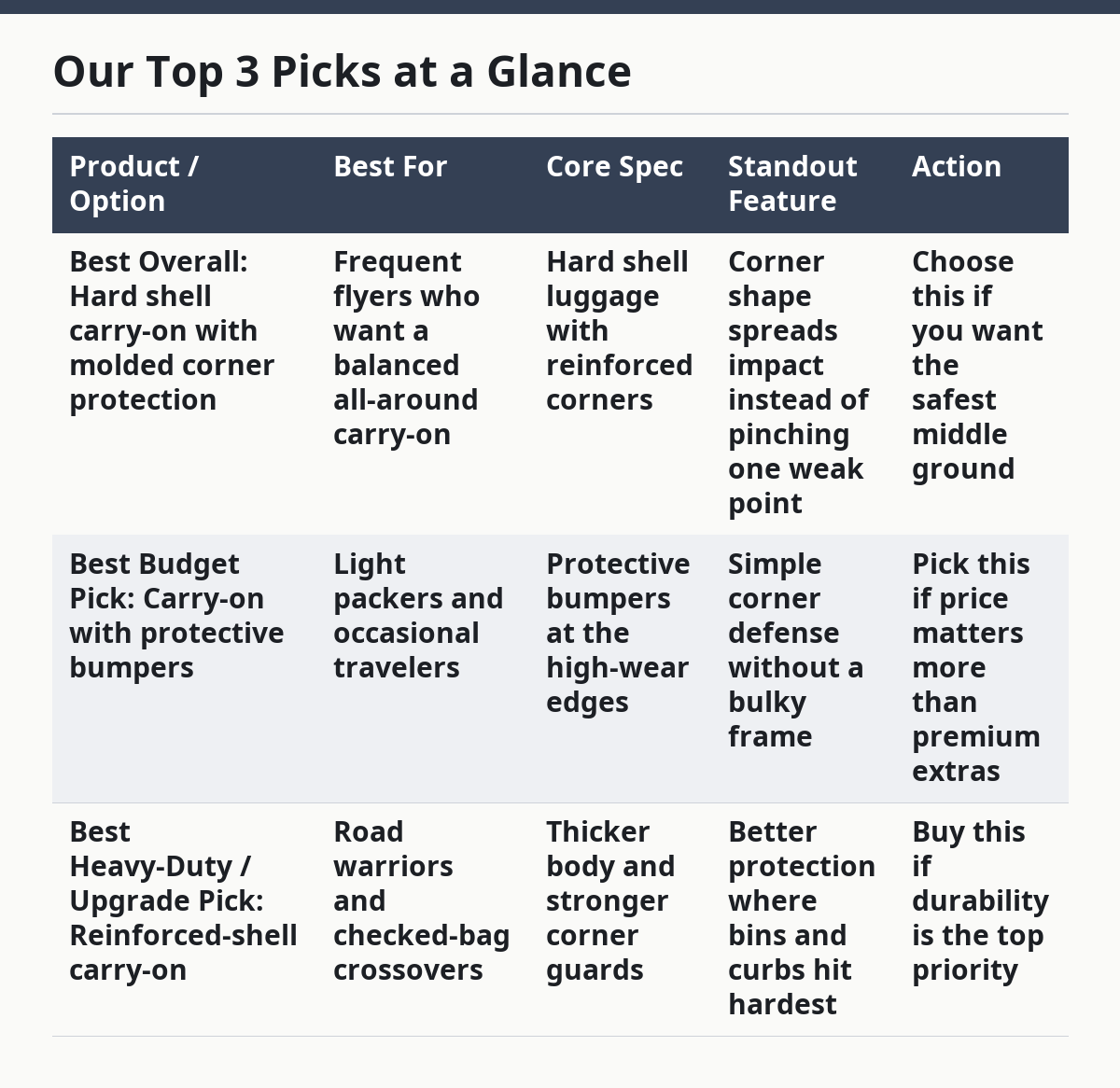
Our Top 3 Picks at a Glance

#1 Best Overall: A hard shell carry-on with molded corner protection and spinner wheels for travelers who want a balanced mix of impact resistance and easy rolling.
#2 Best Budget Pick: A simple carry-on suitcase with protective bumpers and a clean interior frame for someone who wants corner defense without extra parts.
#3 Best Heavy-Duty / Upgrade Pick: A reinforced-shell carry-on with thicker corner guards and a stronger body for frequent flyers who put a bag through tight bins, rough car trunks, and crowded transfers.
| Product / Option | Best For | Core Spec | Standout Feature | Action |
|---|---|---|---|---|
| Best Overall: Hard shell carry-on with molded corner protection | Frequent flyers who want a balanced all-around carry-on | Hard shell luggage with reinforced corners | Corner shape spreads impact instead of pinching one weak point | Choose this if you want the safest middle ground |
| Best Budget Pick: Carry-on with protective bumpers | Light packers and occasional travelers | Protective bumpers at the high-wear edges | Simple corner defense without a bulky frame | Pick this if price matters more than premium extras |
| Best Heavy-Duty / Upgrade Pick: Reinforced-shell carry-on | Road warriors and checked-bag crossovers | Thicker body and stronger corner guards | Better protection where bins and curbs hit hardest | Buy this if durability is the top priority |
The truth is, corner reinforcement matters most when the case meets a hard edge head-on. A spinner wheel helps, but it does not save a soft corner. According to the U.S. Department of Transportation, U.S. airlines carried about 862 million passengers in 2023, so small luggage scuffs add up quickly across frequent trips.
What reinforced corners actually protect on a carry-on
Reinforced corners protect the impact zones that take the first hit when a bag drops, slides, or gets shoved into a bin. That usually means the lower corners near the wheels and the upper corners near the handle side, where the shell gets stress from both pressure and twisting.
Picture this: you’re lifting your carry-on into an overhead bin, and the bag clips the metal lip before it lands flat. A case with protective bumpers spreads that hit across a wider area, so the shell is less likely to crack, split, or show deep gouges. That matters more than a glossy finish or a fancy zipper pull.
A reinforced corner carry-on is usually built in one of three ways:
- A hard shell luggage body with molded corners that rise above the rest of the case.
- Separate corner guards made from a tougher material than the main shell.
- A frame design that keeps the corners from flexing when the case is loaded near the edges.
Here’s the catch: corner reinforcement is not the same as total durability. A bag can have strong corners and still fail at the zipper track, handle mount, or wheel housing. That’s why the best carry-on luggage with reinforced corners is usually judged as a system, not as one visible feature.
The better the corner protection, the more the case usually looks and feels like a shield. That can add a little bulk. It can also reduce the amount of usable interior space around the edges. For a traveler who packs tightly, that trade-off is real.
Which carry-on suitcase style gives the best corner protection?
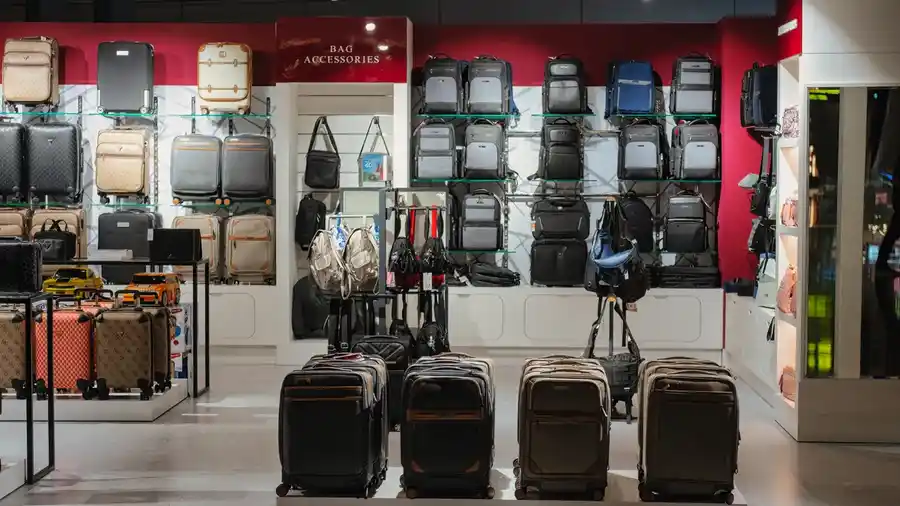
A hard shell carry-on often gives strong corner protection because the shell itself carries the load, not just the fabric or trim. A softside bag can have guards, but those guards sit on top of a more flexible body, so the corner still bends when it gets hit.
Picture this: you’re dragging a bag through a packed terminal and bumping chairs, metal posts, and other luggage. On a hard shell suitcase, the corner bumper takes the scrape first. On a softer bag, the same hit often transfers into the side panel and distorts the frame.
The best part? You do not need the thickest shell on the shelf. You need a case where the corner is clearly part of the structure. Look for:
- Raised corner bumpers that are shaped into the shell, not glued on as decoration.
- A body that stands up on its own without sagging at the corners.
- Spinner wheels mounted in a way that keeps the lower corners from dragging.
That last point matters. A wheel system that sits too far inside the shell can leave the corners exposed when the bag is tilted. A system that sits too low can make the lower edge the first thing to scrape across concrete.
If you’re comparing models in a store, press lightly near each corner. The corner should feel firmer than the middle panel. Not brick-hard, just clearly reinforced.
Best Carry-On Luggage with Reinforced Corners: what to look for in the build
Reinforced corners work best when the bag structure supports them from the inside. A lot of generic advice stops at “get a hard shell,” but that misses the details that decide whether the bag stays square after months of use. Consumer Reports has long emphasized that luggage durability depends on more than shell material alone, which is why build quality matters as much as looks.
Picture this: you’ve packed a week’s worth of clothes, a laptop, and toiletries into a carry-on suitcase, and the corners are now carrying more weight than they should. If the frame is weak, the shell bows outward and the corners stop doing useful work. If the frame is sound, the corners keep their shape.
Use this simple order when judging a bag:
- Check the corner shape first. Raised, molded corners usually handle impact better than flat decorative trim, and the case should still sit level on the floor.
- Look at the wheel placement. Spinner wheels should be anchored cleanly, with no loose-looking mount or exposed edge that can catch on a curb or stair lip.
- Press the shell near the corner and near the center panel. You want a firmer edge and a little give in the middle, not a floppy body from top to bottom.
- Inspect the zipper track or latch line. A strong corner means little if the closure sits under constant strain.
- Open the case and look at the interior frame. Cross-bracing or a clean internal rib pattern helps the shell keep its shape after repeated bumps.
The mistake people make is buying for looks. Deep grooves, shiny finishes, and oversized logos do not tell you much about corner protection. A useful shell is about shape, material thickness, and how the stress moves through the case.
Two authoritative places to cross-check luggage material claims are the ASTM International standards library and the Travel Sentry baggage security guidance, if you want to compare build terms and closure types before you buy. Those are not shopping guides. They are useful when you want the vocabulary to make sense. For airline size rules, you can also check your carrier’s carry-on policy before buying.
Which buyer gets the most value from reinforced corners?
Reinforced corners are worth extra attention for travelers who move fast, pack full, and hate cosmetic damage. They are less useful for someone who always gates checks a bag carefully and rarely sees a hard bump.
Picture this: you travel for work, roll your bag through a train station, and stack it in overhead bins several times a month. In that setting, the corner protection pays off because the same edges get hit over and over. One or two cosmetic scuffs are normal. A cracked corner is not.
This type of carry-on makes the most sense for:
- Frequent flyers who want a bag that keeps its shape over time.
- People who pack near the edges and don’t want the shell to bow.
- Travelers who use spinner wheels and want the lower corners protected from curb strikes.
- Anyone who has had a suitcase fail at the corner before.
It is not the best fit for every traveler. If you always want the lightest possible bag, reinforced corners can feel like extra structure you do not need. If you need maximum soft-sided expansion, a heavily reinforced hard shell may fight your packing style. That is the trade-off.
The honest rule is simple: if the bag is going to spend a lot of time in tight spaces and hard surfaces, reinforced corners earn their keep. If it lives mostly in a car trunk and gets gentle handling, the extra protection may be more than you need. Travel Sentry’s advice on baggage handling also reinforces a simple point: secure closures and sturdy exteriors matter most when luggage gets moved through multiple touchpoints.
The drawbacks that generic articles skip
Reinforced corners solve one problem and can create two others. They can add weight, and they can make the bag less forgiving when you overpack.
Picture this: you load a carry-on to the limit, then try to zip or latch it shut. On a case with thick corner protection, the shell has less room to flex. That can make the closure feel tight even before the bag is truly full. The result is more stress on the zipper track or latch, which is not where you want the load to go.
Common mistakes to avoid:
- Buying a bag because the corners look thick, then ignoring the wheel housing. A weak wheel mount can fail before the shell does.
- Choosing a corner-heavy case with no interior frame support. The shell may survive, but the shape can warp.
- Filling every inch of the bag and expecting the corners to save you. They won’t.
- Assuming all hard shells are equal. Some have better corner geometry; some just have a hard skin.
What it costs: extra weight, less flex, and sometimes less interior space near the edges. What to do instead: choose a carry-on suitcase with visible corner reinforcement, a stable wheel base, and a body that still closes cleanly when packed to normal travel load.
Now, you might be wondering about softside alternatives. That question belongs on a different page. This one is for travelers who want actual corner defense, not a general material comparison.
My practical verdict on the best carry-on luggage with reinforced corners
The best carry-on luggage with reinforced corners is a hard shell carry-on with molded edge protection, spinner wheels, and a frame that keeps the case square under load. That setup gives you the most useful defense where bags usually get hit: corners, wheel edges, and bin contact points.
Picture this: you’re buying for trips that involve overhead bins, tight connection times, and plenty of lifting. You do not need perfection. You need a case that can take repeated edge hits without turning the corners into weak spots.
Choose the Best Overall style if you want the safest all-around pick. Choose the Budget Pick if you mainly need simple corner defense and don’t want extra hardware. Choose the Heavy-Duty / Upgrade Pick if your bag gets knocked around often and you’d rather carry a sturdier shell than replace a cracked one later.
The final check is easy: if the corners look like part of the structure, not decoration, you’re close. If the bag flexes badly at the edges or the wheels look exposed, keep looking. The right carry-on with reinforced corners feels sturdy before you ever pack it.
Drafted with AI; not yet reviewed by a person.




Leave a Reply