

Last updated: November 18, 2026
Quick Answer: “Luggage” usually means 1 or more bags, suitcases, or cases used for travel. In this article, Luggage Ne Demek? Meaning, Use, and Why It Matters is explained in practical travel terms: in Turkish, it is usually understood as “bagaj” or “eşya bagajı,” depending on the sentence. The word matters because travel rules, airline limits, and packing choices all change once you know whether someone means luggage, baggage, or carry-on.
Key takeaways
- “Luggage” is the general travel word for the things you pack and carry.
- In airline talk, the exact item matters more than the word itself: suitcase, carry-on, checked bag, or personal item.
- “Baggage” and “luggage” are close in meaning, but baggage appears more often in airline rules.
- If a trip has a cabin-size limit, the bag’s dimensions matter more than its style.
- A small wording mistake can lead to packing the wrong bag for a flight.
What does “luggage” mean?

“Luggage” means the bags or cases used to carry personal belongings during travel. That includes suitcases, duffel bags, hard-shell cases, and sometimes smaller travel bags, as long as they are part of the trip. Merriam-Webster defines luggage as “suitcases, trunks, bags, and cases for carrying clothing and other belongings when traveling” on its luggage entry.
The word is broad, which is why it shows up in travel guides, airport signs, and shopping pages. A person can say “I need new luggage” even when the real need is one suitcase, one carry-on, or a full set. That broadness helps in everyday speech, but it can hide the details that matter at the airport.
Because of that broad use, a traveler should consult the airline or a travel professional when the trip depends on a cabin rule. If a flight has a cabin-size rule, “luggage” alone is not enough information. A soft bag, a spinner suitcase, and a backpack can all count as travel bags, but they may not fit the same rules.
Is luggage the same as baggage?
Luggage and baggage are close, but baggage is the word airline systems use more often. In daily speech, many people treat them as the same thing, yet baggage is the term that appears in check-in counters, baggage claim areas, and airline policy pages. Cambridge Dictionary also lists luggage as bags or suitcases used when travelling on its luggage page, which shows how the word sits near baggage in meaning.
The difference is mostly about context. Luggage sounds natural in conversation and shopping. Baggage sounds more formal and more airline-specific. A traveler might ask, “How much luggage can I bring?” but the airline will usually answer in baggage terms, with limits for carry-on baggage and checked baggage.
| Criteria | Luggage | Baggage | Winner for this condition |
|---|---|---|---|
| Everyday speech | Natural and common | Also understood, but slightly more formal | Luggage |
| Airline rules | Used loosely | Used in policy language | Baggage |
| Shopping for bags | Fits product listings well | Less common on retail pages | Luggage |
| Check-in desk language | Understandable | Standard wording | Baggage |
| Talking about one suitcase | Clear enough | Clear enough | Tie |
| Talking about all travel items | Broad and flexible | Broad and flexible | Tie |
| Cabin limits and fees | Too general on its own | Better for official rules | Baggage |
| Casual conversation | Smooth and simple | Slightly stiff | Luggage |
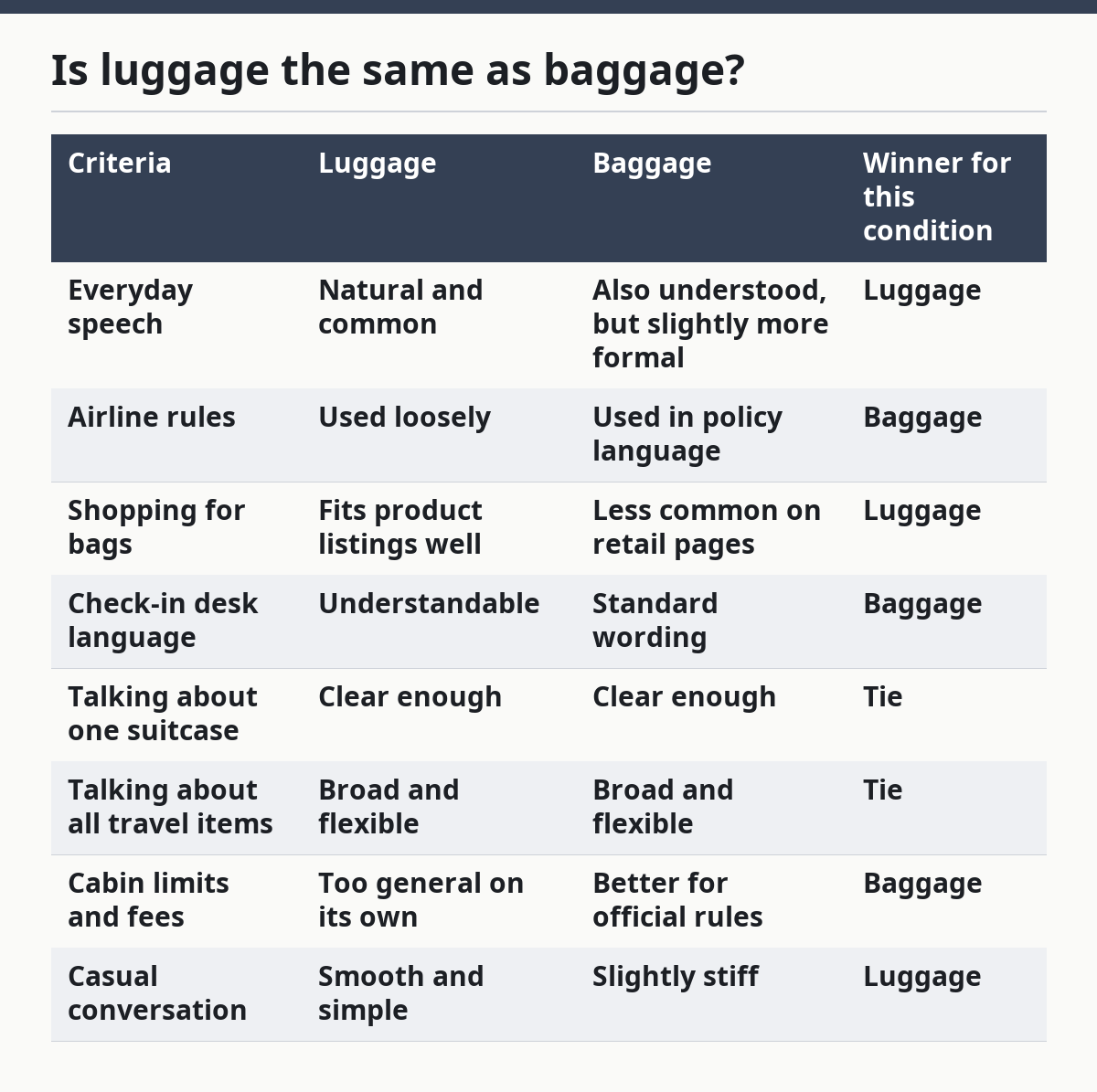
For a traveler, the safer habit is simple: use “luggage” when talking casually, but read airline rules as baggage rules. That avoids the common mistake of assuming every bag is treated the same, so it is wise to check the official rule or consult a professional when a flight depends on bag size or fees.
Why does the word matter for travel?

The word matters because it can change what a traveler packs, buys, or checks. If someone hears “luggage” and thinks only of large suitcases, they may miss that a small cabin bag or backpack also counts in some airline systems. One word can be broad, but the airline still cares about exact size, weight, and bag type.
This is where the meaning becomes practical. A traveler looking for a “carry-on luggage size guide” is not really asking for a dictionary definition. The real question is: what kind of bag fits in the cabin without extra fees or a gate check? That is why the word “luggage” matters less than the category behind it.
Travelers also use the word when comparing what to buy. A hard-shell suitcase, a soft-sided trolley, and a duffel bag all qualify as luggage, but each solves a different problem. One may protect fragile items better, while another may squeeze into tight spaces more easily.
Because luggage can mean several bag types, it is safest to check the exact policy before buying or packing. Consult the airline or a travel professional if the trip has a fee, size limit, or special baggage rule.
What is the difference between carry-on luggage and checked luggage?
Carry-on luggage is the bag you keep with you in the cabin, while checked luggage is the bag you hand over at the counter or gate. That is the simplest and most useful distinction. The airline’s rules for each can be different, and the limit for one does not tell you the limit for the other.
Carry-on luggage wins when you want faster airport movement and fewer handoffs. It stays with you, so you do not wait at baggage claim and you lower the risk of a missing bag. The downside is space. Cabin bags are smaller, and that can force careful packing, especially on longer trips or trips with cold-weather clothing.
Checked luggage wins when you need more room. It is the better choice for bulky items, multiple outfits, or trips where packing light is not realistic. The trade-off is time and risk: you wait longer, and you depend on airline handling.
How do you choose the right kind of luggage?
The right kind of luggage depends on trip length, airline rules, and how much you can carry comfortably. A short trip with cabin travel often points to a compact carry-on. A longer trip, a family trip, or a trip with special gear often points to checked baggage or a larger suitcase.
The key decision is not style first; it is size first. A bag can look sleek and still fail the airline’s cabin rules. A bag can be plain and still work perfectly if it fits the limit and holds what you need. That is why buying by appearance alone is a bad plan.
Here is a simple way to think about it:
- Choose carry-on luggage if you want speed, control, and less waiting.
- Choose checked luggage if you need more space than the cabin allows.
- Choose a backpack or smaller travel bag if the trip is very light and the airline allows it.
- Choose a hard-shell suitcase if protection matters more than flexible packing.
The biggest mistake is buying one “luggage” piece for every trip. One bag rarely fits every route, airline, and season.
Which bag type fits the word best?
A suitcase is the clearest match for “luggage,” but the word can cover more than that. When people say luggage, they usually picture a suitcase first, then a roller bag, then a travel case. A backpack can count as travel luggage in a broad sense, but it is less likely to be the first thing a shopper imagines.
That broadness helps and hurts at the same time. It helps because the word works for many travel setups. It hurts because it hides important differences in shape, capacity, and airline treatment. If the real question is “Will this fit overhead?” then the bag’s size label matters more than the word luggage.
For a traveler, a practical rule is this: use the word to start the conversation, then switch quickly to the exact bag type. Say “carry-on suitcase,” “checked suitcase,” or “personal item” when the detail matters. That is the language airlines and stores understand best.
When should you stop saying luggage and ask for the exact rule?
You should ask for the exact rule when the trip involves an airline, a train with size limits, or a bag that might need to fit under a seat. “Luggage” is too general for those situations. A cabin limit, a weight cap, or a fee policy can turn a normal-looking bag into the wrong choice.
This is especially important for carry-on planning. A bag that seems small in a store may still be too tall, too wide, or too deep for a specific airline. The shape matters too: pockets, handles, wheels, and expandable zippers can all change how the bag fits.
The most useful habit is to check the exact wording in the carrier’s policy. If the policy says “carry-on baggage,” read that as a measurement problem, not a style question. The right bag is the one that matches the rule, not the one that sounds nice in a product title.
What should a beginner remember first?
A beginner should remember that “luggage” is a general word, not a rule. It tells you that the item is for travel, but it does not tell you if the bag belongs in the cabin, the hold, or under the seat. That detail comes from airline policy, not the dictionary.
The second thing to remember is that luggage and baggage are close enough for casual speech, but baggage is the safer word when reading official travel rules. The third thing is that size beats style. A bag that fits is more useful than a bag that looks right.
If the goal is to avoid travel mistakes, the order is simple: word, category, size, then airline rule. Skip any of those steps, and the wrong bag can become an expensive nuisance.
What are the most common related questions?
The most common follow-up questions are about the difference between luggage and baggage, what counts as carry-on luggage, and whether a backpack counts as luggage. These questions matter because the word alone does not settle the packing problem. Size, airline policy, and bag type still decide the answer.
A second group of questions comes from shopping. People want to know whether luggage means one suitcase or a full set, and whether a small cabin bag counts. The answer is usually yes to both, but only if the context is clear. That is why shopping pages and airline rules can feel inconsistent: they use the same word for different levels of detail.
FAQs
Does “luggage” mean suitcase?
Yes, but not only suitcase. “Luggage” can mean suitcases, bags, cases, and other travel containers, so the word is broader than one shape. In daily speech, many people use “luggage” when they really mean “suitcase,” but that is a shortcut, not a strict definition.
What is the difference between luggage and baggage?
The difference is mostly about usage, not meaning. “Luggage” is common in everyday conversation, while “baggage” is more common in airline rules and formal travel language. If the topic is a flight policy, baggage is usually the better word.
Does a backpack count as luggage?
A backpack can count as luggage in a general travel sense. In airline terms, though, it may be treated as a personal item, carry-on, or just a backpack, depending on the rule. Consult the airline or a travel professional if the category matters for your trip.
Is luggage plural or singular?
“Luggage” is usually treated as an uncountable noun, so people do not normally say “one luggage” in standard English. They say “a piece of luggage,” “some luggage,” or “two bags.” That is one reason the word can feel a little awkward in English if translated too directly; if you need exact wording for a form or policy, consult a professional.
Why do people search for luggage meaning when buying travel bags?
They often want to know whether a product title refers to a suitcase, a set, or a general travel bag. The meaning helps, but the size and airline category matter more before a purchase. A bag can be called luggage and still fail a cabin-size rule.
Drafted with AI; not yet reviewed by a person.




Leave a Reply