
Last updated: November 18, 2026
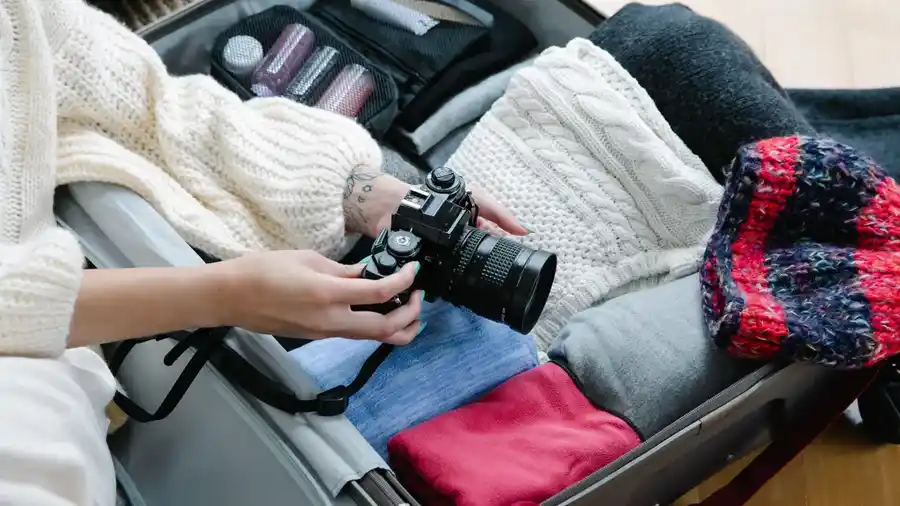
Quick answer: in most cases, 3 core items should stay in the cabin—camera body, lenses, and spare batteries—because the Carry-On Rules for Traveling with Photography Gear usually favor fragile items being with you, not in checked luggage. The main rule is simple: keep fragile gear with you, pack batteries with care, and make security screening easy to inspect. For the FAA lithium battery guidance, see its PackSafe page, and for screening basics, see the TSA’s “What Can I Bring?” guidance: https://www.tsa.gov/travel/security-screening/whatcanibring/all
Key takeaways
- Put the camera body, lenses, memory cards, and spare batteries in your cabin bag, not in checked luggage.
- Use padding and separators so metal mounts and glass do not knock together.
- Battery rules matter more than brand names; watt-hours and loose terminals are the things to watch.
- A carry-on suitcase gives more structure, while a camera bag gives faster access.
- If the kit is large, a personal item may be too small unless the setup is minimal.
What can go in a carry-on?
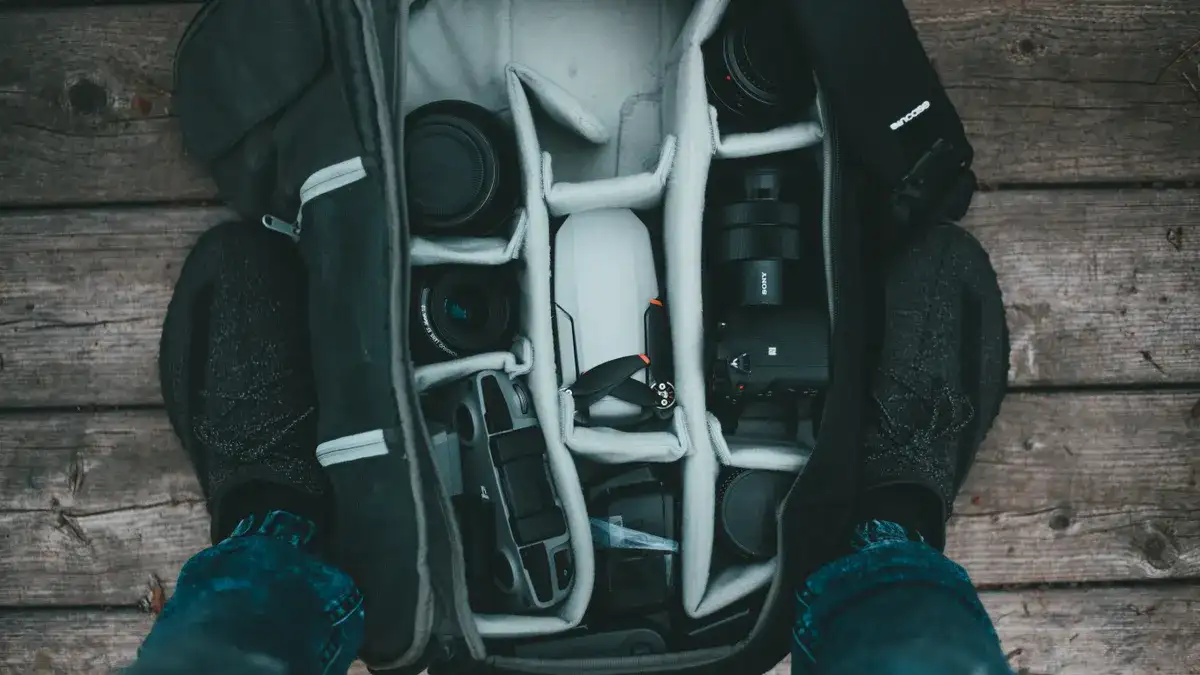
You can usually bring a camera, lenses, memory cards, and spare batteries in a carry-on bag. In the Carry-On Rules for Traveling with Photography Gear, that is usually the best place for fragile gear, because checked bags are handled multiple times and can be stacked with heavier luggage.
The cabin is also where security staff can inspect the gear without sending it out of your sight. A camera body with a mounted lens, a second lens, a charger, and a few cards is the kind of kit that fits the cabin rule well. A tripod is different: small travel tripods may fit in a cabin bag, but longer ones often do not, so check the airline’s size rules before you leave.
However, the hard line is not to treat every piece of photo gear the same way; if you are unsure, consult the TSA or your airline before you travel. Memory cards are tiny and easy to keep close. A full-frame body with a 24-70 mm lens needs padding. A loose battery needs its contacts protected. A fragile filter should not rattle around in the same pocket as keys or coins.
The real trade-off is space. A cabin bag protects gear better, but it can crowd out clothes fast. That is why a photographer with one body and two compact lenses can often travel light, while someone carrying two bodies, four lenses, and flashes may need a bigger bag plan. This page is not for travelers trying to fit a full studio into one small personal item.
Therefore, the TSA’s “What Can I Bring?” guidance is the right place to check item-by-item rules, and the FAA’s lithium battery guidance is the source for battery packing rules. The FAA’s PackSafe lithium battery page is especially useful because it explains why spare lithium-ion batteries belong in the cabin.
TSA: https://www.tsa.gov/travel/security-screening/whatcanibring/all
FAA PackSafe: https://www.faa.gov/hazmat/packsafe/lithium-batteries
How should camera gear be packed?
Camera gear should be packed so each hard object has its own space and each lens has a soft barrier around it. The goal is not just to fit everything; it is to stop glass, metal, and battery terminals from touching each other during a 2-hour hop or a long haul.
A simple packing order works better than stuffing the bag by feel:
- Put the heaviest item, usually the camera body, near the bag’s center and close to your back or the suitcase wheels. That keeps the load stable.
- Place each lens in a padded slot or wrap it in a soft cloth if you do not have dividers. The front element should not face a hard edge.
- Store memory cards in a small case so they do not slide under other gear. A card wallet beats a loose side pocket.
- Put spare batteries where the contacts cannot touch metal. A case is best; tape on the terminals is a backup if a case is not available.
- Keep the charger, cable, and adapter in one section so you do not dig through the bag at security.
- Leave a little empty space near the zipper so the bag closes without pressing hard on the lens barrel.
Padding and separators matter because impact damage is rarely dramatic. A lens does not need to fall out of a bag to get hurt; one sharp bump against a body mount or another lens can be enough to cause a problem later. A divider system inside a camera bag works better than loose clothing because it holds shape and stops items from shifting on a 45-minute taxi ride to the airport.
A carry-on suitcase can work too, but only if the inside is structured. Soft piles of clothing under a camera body are not the same as proper separators. If the bag has no built-in structure, use inserts or a padded wrap so the gear does not move every time the suitcase tilts.
What about camera batteries?
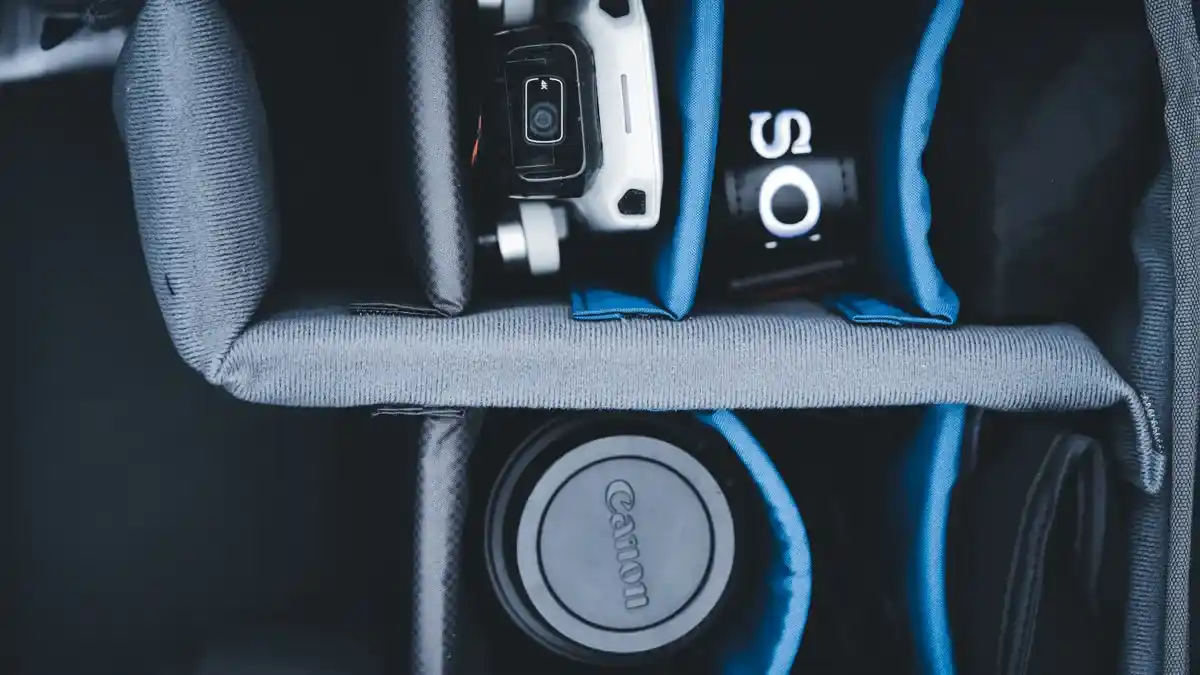
Camera batteries should go in the cabin, and loose lithium batteries need terminal protection. That is the most important battery rule for photography gear, and it is where travelers get tripped up most often.
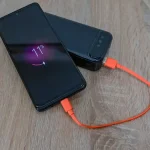
The FAA says spare lithium-ion batteries under 100 watt-hours are generally allowed in carry-on bags, while spare batteries are not meant for checked luggage. That matters for camera kits because mirrorless systems often run on rechargeable packs, and many accessories use the same battery chemistry. Power banks follow the same basic logic: cabin, not checked, with the terminals protected.
Here is the practical version of that rule:
- Keep spare batteries in your camera bag or personal item.
- Use the original box, a battery case, or individual plastic covers.
- Do not leave loose batteries where metal can bridge the contacts.
- Remove a battery from the camera only if it helps inspection or prevents accidental power-on, and consult the TSA or your airline if you are unsure.
- If a battery shows damage, swelling, or exposed contacts, do not pack it with normal gear.
The common mistake is treating “small battery” as “no rule,” so if you are unsure, consult the FAA guidance before you fly. Battery size still matters, but the real checkpoint issue is not size alone. A loose pack in a backpack pocket can short against keys or coins. That is why a case is worth the extra space.
There is also a judgment call here. A traveler carrying one camera body and one spare battery has an easy job. A person bringing multiple spares, flashes, and charging bricks needs more cabin space and more organization. This is not the kit for someone who wants to dump everything into a single open-top tote and hope for the best.
For a formal source, the FAA PackSafe battery guidance is the clearest reference on the common 100 watt-hour threshold and cabin storage.
FAA PackSafe: https://www.faa.gov/hazmat/packsafe/lithium-batteries
How do lenses stay protected?
Lenses stay protected when they cannot roll, press, or knock into hard edges. The lens barrel and front element are the parts most likely to take damage, so the packing method should stop movement first and cushion second.
A good rule is to give each lens its own pocket, divider, or wrap. Wide lenses and zooms with larger barrels are less forgiving than tiny primes because they have more surface area to hit the bag wall. A front cap helps, but a cap alone is not enough if the lens can slide around.
The best protection comes from a layered setup:
- a padded compartment or insert,
- a soft divider or cloth wrap,
- a front and rear cap on the lens,
- and a firm placement so the lens does not rattle.
A lens should not sit loose beside a charger or hard drive. It should also not be packed with the mount facing a zipper seam or the outer wall of the bag. That is a fast way to get scuffs, and scuffs are the mild version of the problem. A stronger hit can misalign parts inside the lens.
If a photographer uses filters, keep them in a flat case rather than screwing them on and forgetting them. That makes breakage less likely, and it keeps fingerprints off the glass before you even reach the gate.
This is one place where a camera bag usually beats a standard travel bag. A camera bag is built around dividers, while a general carry-on suitcase may need extra inserts to stop lens movement. The better choice is the one that keeps each lens from shifting during a 10-minute rush from curb to checkpoint.
Should camera gear go in a personal item?
Camera gear should go in a personal item only if the kit is small enough to fit without squeezing the gear or making access impossible. A personal item is great for a body, one lens, batteries, and cards; it is cramped for a full multi-lens setup.
Here is the simplest comparison:
| Place to pack it | Best for | Weak point | Good fit for |
|---|---|---|---|
| Personal item | Fast access and close control | Limited space | One body, one lens, spare batteries, cards |
| Carry-on suitcase | More padding and more structure | Slower to reach at the seat | Multiple lenses, charger, filters, extra body |
| Camera bag | Dividers and quick grab access | Can be bulky | Frequent shooting between flights |
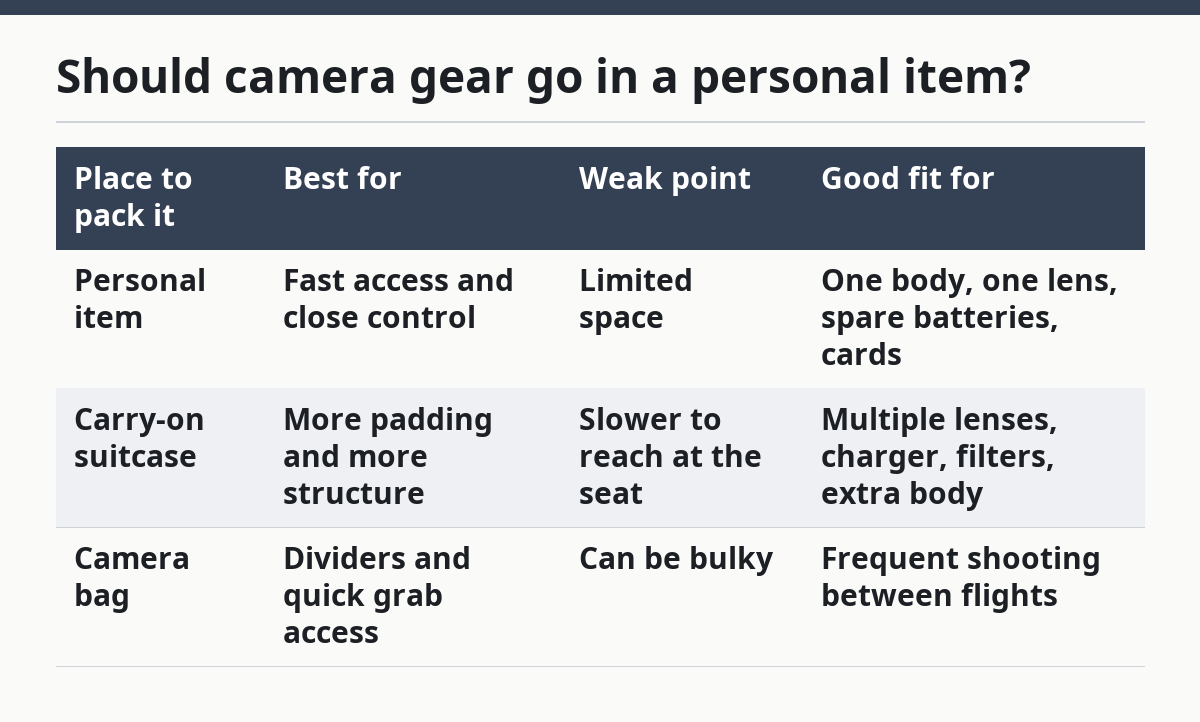
The personal item wins when you need the gear at your feet and want to pull out a body before landing. The carry-on suitcase wins when the main goal is protection. The camera bag wins when the priority is keeping the setup organized and easy to reach.
The trade-off is simple: the more accessible the gear is, the more likely it is to be limited by size. A small bag can stay under the seat, but it may not hold a padded lens cube and a charger at the same time. A larger cabin bag protects better, but it may live in the overhead bin, which means no quick access during the flight.
The wrong move is trying to make one bag do every job. A camera bag stuffed too full loses structure. A carry-on suitcase without dividers lets lenses slide. A personal item packed to the zipper can make security screening slow and awkward.
This is why the most practical setup is often a split load: the camera body and most delicate items in the personal item, and the extra lens or bulkier accessories in the carry-on suitcase.
What gets people stopped at security?
People usually get stopped because the bag is hard to read, not because the gear itself is forbidden. Security screening goes faster when the camera and batteries are visible, organized, and easy to remove if asked.
A few habits prevent most delays. Keep memory cards in a case, not loose in a pocket. Place batteries where they can be reached quickly. Avoid stuffing cables around the camera body in a way that makes the X-ray image messy. If the bag has a laptop sleeve or dense fabric layers, expect a slower look simply because the contents are harder to scan.
The biggest mistake is burying small items. A memory card can hide under a divider, and a spare battery can slip into a side seam. That costs time at the checkpoint and can lead to the bag being opened twice. The fix is simple: one small case for cards, one case for batteries, and one clear pocket for cables.
A second mistake is overpacking the bag to the point that zippers strain. That makes repacking harder after screening and can leave less cushion around the gear. If the bag closes only by force, there is not enough room for safe movement in transit.
A third mistake is forgetting that access matters after the checkpoint too. A camera in a deep overhead bag is hard to reach if the flight offers a brief view or a rare shot through the window. If quick access matters, place the camera near the top of the bag or in the seat-side personal item.
For broader cabin planning, this article fits the larger hub on carry-on luggage for air travel situations. The difference here is the gear itself: padding, batteries, and lens protection matter more than general packing tricks. See also the related guides on carry-on luggage rules, battery travel rules, and camera bag packing.
FAQ
Can I bring camera batteries in a carry-on?
Yes, camera batteries usually belong in a carry-on bag. Spare lithium-ion batteries should not be treated like checked luggage filler, and the FAA guidance points travelers toward cabin storage with protected terminals.
A battery case is the cleanest option. If a case is not available, keep the contacts from touching metal or other loose items.
How do I protect lenses in a carry-on?
Protect lenses by stopping movement first and using padding second. Each lens should sit in its own divider, wrap, or padded slot so it cannot roll into a hard edge during a 30-minute ride or a long flight.
Front and rear caps help, but the real protection comes from keeping the lens from shifting inside the bag. A loose lens is always the risky lens.
Should camera gear go in a personal item?
Yes, if the kit is small enough to fit without pressure on the gear. A personal item is best for a body, one lens, memory cards, and spare batteries, because those are the things you may want within arm’s reach.
A larger kit usually needs a carry-on suitcase or a dedicated camera bag. If the bag must be forced shut, it is too full for safe packing.
Drafted with AI; not yet reviewed by a person.



Leave a Reply