
Last updated: November 19, 2026
Quick answer: for most Qantas trips, a 1-bag carry-on setup is the fastest option if it fits your fare; otherwise checked luggage is the safer backup. Luggage Qantas: Your Guide to Hassle-Free Travel: related questions usually come down to the allowance on your ticket, the route, and whether you want to move through the airport with less hassle. The exact allowance can change by fare, route, and status, so the two pages to check first are Qantas’s baggage page and its baggage calculator.
Key takeaways
- The right bag choice on Qantas depends on space, time, and how much you want to carry through the airport.
- Carry-on is the cleaner option for short trips, but only if your bag fits the current cabin rules.
- Checked luggage makes sense when you have liquids, gifts, or bulky items that would slow you down at security.
- Qantas baggage rules are not one-size-fits-all, so the booking page matters more than a generic packing tip.
- If you are unsure, it is usually wise to confirm the allowance before you leave home rather than at the check-in counter.
What makes Qantas luggage simple?
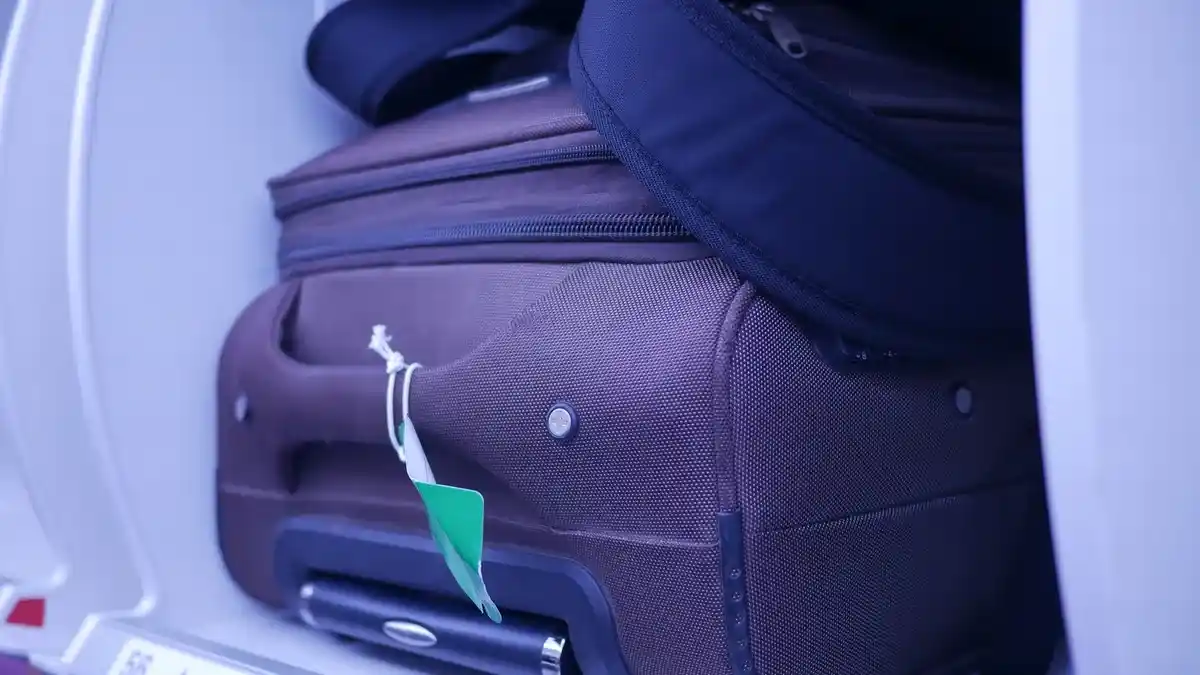
Because the booking page is the source of truth, Qantas luggage is simple when you treat it as the starting point, not a memory from a past flight. The airline’s baggage rules can change with the fare type, route, and cabin, so the first job is to confirm what your ticket actually includes.
That matters because the same suitcase can be fine on one booking and too much on another. A generic travel rule like “just take a small bag” is not enough when an airline ties allowances to ticket class and flight length. The Qantas baggage calculator and baggage page are the right starting points because they show the rules tied to your trip, not a guess.
This is also where many travelers go wrong: they pack first and read later. That is backwards. If your trip includes a short connection, a tight airport transfer, or a lot of airport walking, the question is not “What fits best in theory?” It is “What will still be easy after security, boarding, and arrival?”
For a reliable source, start with Qantas’s baggage information page and the airline’s own baggage calculator, and if the details are still unclear, consult a qualified travel professional:
- Qantas baggage page: https://www.qantas.com/au/en/travel-info/baggage.html
- Qantas baggage calculator: https://www.qantas.com/au/en/travel-info/baggage.html#baggage-calculator
- CASA cabin baggage guidance: https://www.casa.gov.au/travellers-and-public/cabin-baggage
Carry-on or checked bag?
Carry-on wins for speed, while checked luggage wins for space. If the trip is short, the bag is light, and you can keep liquids and sharp items within airline and aviation rules, cabin-only travel is the least annoying option.
The trade-off is obvious: carry-on keeps your bag with you, but it also puts a hard limit on what you can bring. A 4-day city break, a business trip, or a hop where you only need clothes and a laptop usually fits that model well. Checked luggage is better when you need extra pairs of shoes, gifts, sports gear, or anything awkwardly shaped.
There is also a point many people miss: the cheapest-looking option is not always the easiest one. A bag that seems “small enough” can still create a delay if it needs to be gate-checked, repacked, or split at the counter. That is why the right choice depends on what you value more: time or capacity.
Here is the clean comparison.
| Criteria | Carry-on | Checked bag | Winner for this condition |
|---|---|---|---|
| Airport speed | You keep moving after security | You add bag drop and carousel time | Carry-on for tight schedules |
| Packing space | Limited | Much larger | Checked bag for longer trips |
| Security screening | Faster if contents are simple | Less hassle at the gate, but bag goes out of sight | Carry-on for lighter packing |
| Liquids and bulky items | Harder to manage | Easier to pack | Checked bag for toiletries and gifts |
| Risk of waiting on arrival | Low | Higher, because you wait for the belt | Carry-on for connections |
| Risk of overweight surprises | Lower, if you pack light | Higher if you overfill | Carry-on for disciplined packers |
| Flexibility on return | Lower if you buy extras | Better for shopping or souvenirs | Checked bag for return trips |
| Ease with children or work gear | Better for one small kit | Better for family or mixed items | Checked bag for complex packing |
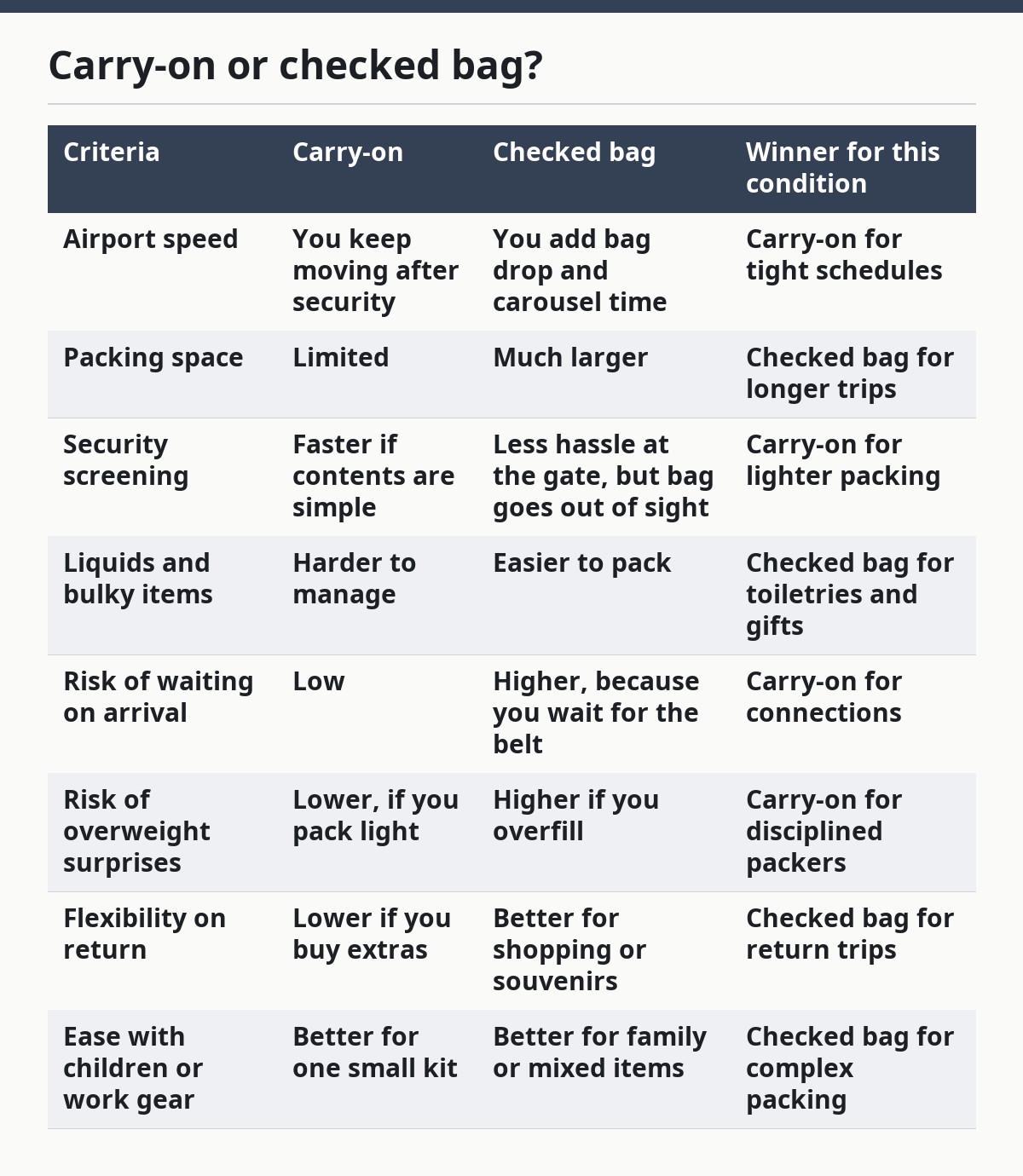
The honest call is simple: carry-on is the better choice for a minimalist traveler; checked luggage is the better choice for anyone who packs with “just in case” in mind. For a tighter fit, compare your bag against a carry-on checklist before you leave.
What should go in your cabin bag?

Your cabin bag should hold the items you cannot afford to lose time on, not everything you own. That means documents, medication if relevant, chargers, one change of clothes if the trip is important, and anything fragile or valuable you do not want in a bag hold.
This is where travelers often overpack the wrong category. A cabin bag is not a second suitcase; it is a survival kit for the first 24 hours. If your checked bag is delayed, the cabin bag is what keeps the trip usable. That is why essentials beat volume every time.
A good rule is to keep the cabin bag boring and easy to inspect. Loose cords, heavy bottles, and random small items make security checks slower. A neat layout saves time and reduces the chance that you need to unpack at the screening point. For a simple airport setup, see the related guide on carry-on packing and the related guide on airport security.
There is also a safety angle. Aviation rules can restrict certain items, and some things that look harmless at home become a problem in the airport. For lithium batteries and other restricted items, check the Civil Aviation Safety Authority guidance before you pack: https://www.casa.gov.au/travellers-and-public/cabin-baggage
If you want the practical answer in one line, it is this: the cabin bag should cover the first day, not the whole trip. That is the difference between a smart carry-on and a stuffed one.
When does checked luggage make more sense?
Checked luggage makes more sense when the cost of carrying the bag is higher than the cost of waiting for it. If you are traveling with bulky clothing, gifts, sports gear, or a family’s worth of items, checked baggage usually beats trying to force everything into the cabin.
It also wins when your packing style is not minimalist. Many travelers do not want to think about bottle sizes, bag shape, or whether a jacket should be worn instead of packed. Checked baggage gives more room for that kind of trip. It can also reduce the stress of gate checks, where a bag that looked fine earlier suddenly becomes a problem.
The downside is just as real. Checked luggage introduces more handoffs, more waiting, and more chances for a delay between you and your things. If the trip is short or the arrival matters, that can be annoying. If the bag contains a suit, gifts, or event items, the consequence can be worse than inconvenience.
This is why checked luggage is not the “better” option in general. It is better only when the trip demands space more than speed. A 2-week holiday, a family trip, or a return leg with shopping tends to fit that profile. A quick work visit usually does not. For longer itineraries, the related guide on checked baggage can help you compare the trade-offs.
One more practical point: if you are packing anything fragile, it should not be casually tossed into checked baggage without protection. A hard case helps, but the better question is whether the item should travel at all.
What do people get wrong at the airport?
People usually get luggage wrong by packing for the destination instead of the airport process. The mistake sounds small, but it creates the line, the repack, and the extra fee that nobody planned for.
The first mistake is assuming the allowance is fixed across every Qantas trip. It is not. The fare, route, and booking details can change the answer, so “I flew with this bag before” is weak evidence.
The second mistake is treating the bag as finished before weighing or measuring it. If it is close to the limit, even a small change in what you packed can matter. If you are unsure, compare the bag against the Qantas calculator and, if needed, ask a qualified travel professional before you leave.
The third mistake is leaving all the important items in checked luggage. If the bag is delayed, that can turn a normal trip into a hassle within the first 6 hours. A cabin bag with the basics is the insurance policy most people forget to pack.
The fourth mistake is ignoring the return leg. A bag that works on the way out may fail on the way back after souvenirs, laundry, or business materials are added. If you leave with a nearly full suitcase, you have already chosen the hard version of the trip.
The best fix is simple: check the Qantas baggage page, pack once, and leave a little room. That habit is not flashy, but it beats last-minute guessing at the airport. For a fuller planning step, see the related guide on travel packing.
Which luggage choice should you make?
Choose carry-on if your trip is short, your packing is light, and you want the fastest airport experience. Choose checked luggage if you need more room, hate strict cabin packing, or are carrying items that should not sit overhead with you. Neither is right if your bag cannot fit the current allowance or you have not checked the rules for your fare.
That verdict is firm because the wrong choice usually shows up as friction, not drama. Carry-on saves time but punishes overpacking. Checked luggage adds room but costs you speed and control. The best answer is the one that matches your trip, not the one that sounds simpler in theory.
There are a few exception cases where the overall advice flips. If you are carrying fragile work gear, a wedding outfit, or something you must have at arrival, cabin-only can be worth the restrictions. If you are traveling with a child, a long return trip, or extra shopping space, checked luggage becomes the practical answer even for a short journey. And if your bag is already near the cabin limit, the smarter move is to check it rather than gamble at the gate. A quick look at booking details can help you sort that out before you leave home.
The real test is not “Which bag is best?” It is “Which bag makes this specific Qantas trip easier from curb to arrival?”
What should you check before you leave home?
Check the booking page, the baggage calculator, and the restrictions for the items in your bag before you leave home. That last check matters because the airport is the worst place to discover that your packing plan was wrong.
The simplest preflight routine has three steps. First, confirm the allowance tied to your ticket. Second, decide what must stay with you and what can go in the hold. Third, make sure the bag itself is actually within the rule you are using, not the one you remember from another trip.
This is also the point to think about route changes and baggage transfer. A 1-stop trip can be more sensitive to luggage mistakes than a direct one, because each handoff gives the bag one more chance to become a problem. The more connections you have, the more useful a tidy cabin bag becomes. If your route changes, recheck the connection travel guide before you pack.
The practical answer is not glamorous, but it saves trouble: read the current Qantas rules, pack to them, and stop relying on old assumptions. That is the nearest thing to hassle-free luggage travel.
What are the most common Qantas luggage questions?
How do I know if my bag is cabin size?
The safest answer is to check the current Qantas baggage page for your booking. Cabin size depends on the flight and fare, so a bag that worked on a previous trip may not be the right one now.
Should I take one large suitcase or two smaller bags?
Two smaller bags can be easier to move, but only if they still fit the current allowance. One large suitcase is simpler to track, yet it can become awkward if it is too full or too heavy for your plan.
Is checked luggage better for a long trip?
Yes, usually, because longer trips need more space for clothes, toiletries, and extras. A trip of 7 days or more often makes checked baggage the more practical option, especially if you are not packing very light.
What if I am unsure about my allowance?
Check the Qantas baggage calculator before travel and use the booking details tied to your ticket. If the answer is still unclear, treat the smaller, safer option as the one to plan around so you are not stuck at the counter.
Drafted with AI; not yet reviewed by a person.




Leave a Reply