
Last updated: November 19, 2026
Quick answer: for most UAE trips, 1 cabin bag is enough for short stays, while 1 checked suitcase usually works better for trips of 5 nights or more. In this guide to Luggage Essentials in the UAE: Your Travel Guide: related questions, the right setup depends on your airline’s size limits, the season, and how much time you will spend in airports, malls, beaches, or desert areas.
Key takeaways
- A 55 x 40 x 20 cm cabin bag is a common benchmark, but airline rules still decide what fits.
- Keep passports, prescriptions, phones, chargers, and a change of clothes in the bag you can reach fast.
- Light layers work better than bulky clothes because indoor spaces in the UAE often use strong air conditioning.
- Checked bags make sense for longer stays, family trips, or anything bulky; cabin bags win for quick trips and tight transfers.
- For customs and security questions, official sources matter more than packing lists from blogs. The International Air Transport Association has baggage guidance, and the UAE government portal explains entry and customs rules. See IATA baggage guidance and the UAE government portal.
What luggage size works best in the UAE?
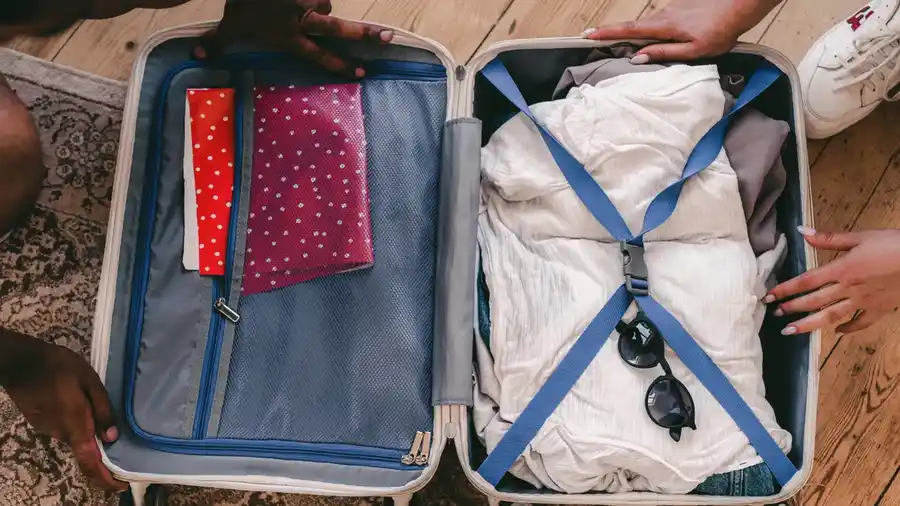
Therefore, a cabin bag usually works best for short UAE trips, but only if it matches the airline’s size and weight rules. A common cabin benchmark is about 55 x 40 x 20 cm, yet that is not a universal right; the ticket or airline policy controls the final answer.
Because of that, the UAE can change the packing plan by airline, weather, and setting. Flights into Dubai, Abu Dhabi, and Sharjah can come with different baggage allowances even on the same route. A bag that fits one airline may need to be checked on another. The practical move is to match the bag to the strictest airline you are likely to use, not the loosest one.
Since the UAE also changes the packing plan by weather and setting, a trip in August needs lighter clothing, while business travel may need a second pair of shoes and a pressed outfit. If the itinerary includes mosques or formal visits, modest layers matter more than a pile of extras.
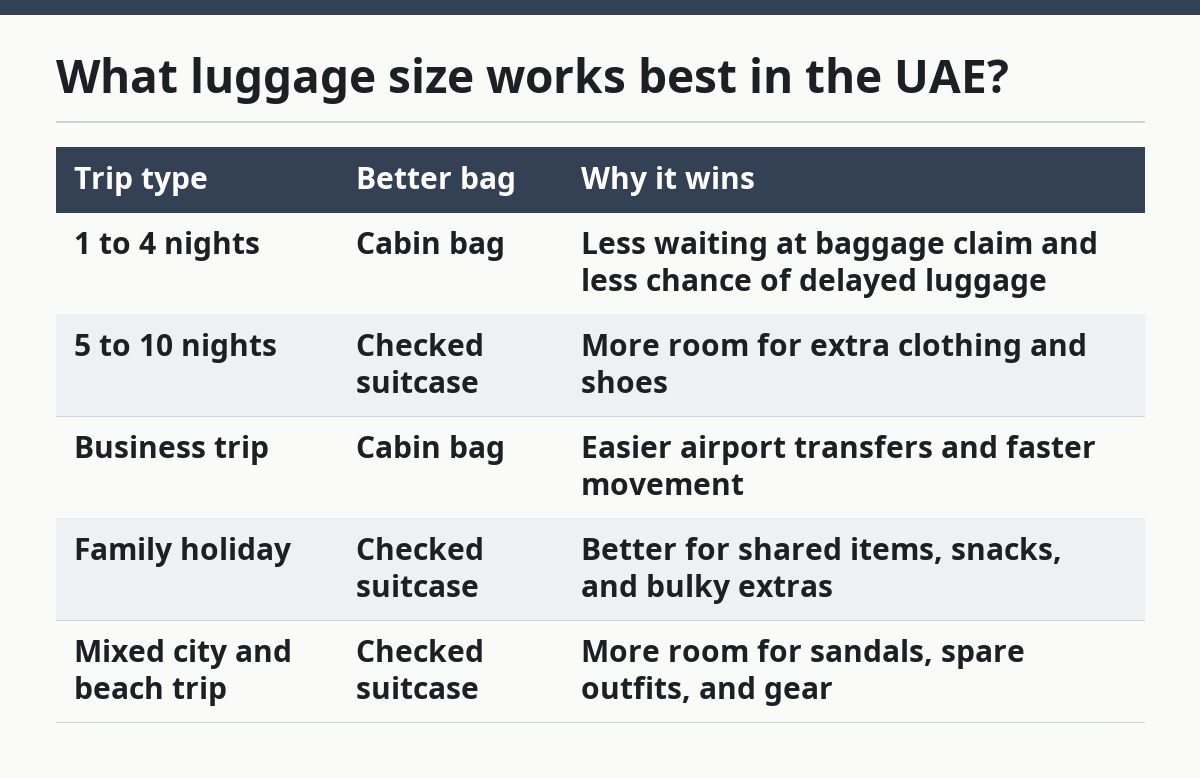
For a quick reference, the choice usually looks like this:
| Trip type | Better bag | Why it wins |
|---|---|---|
| 1 to 4 nights | Cabin bag | Less waiting at baggage claim and less chance of delayed luggage |
| 5 to 10 nights | Checked suitcase | More room for extra clothing and shoes |
| Business trip | Cabin bag | Easier airport transfers and faster movement |
| Family holiday | Checked suitcase | Better for shared items, snacks, and bulky extras |
| Mixed city and beach trip | Checked suitcase | More room for sandals, spare outfits, and gear |
For example, the mistake many first-time visitors make is buying luggage for the destination, not the airline. A hard shell with the wrong dimensions is still the wrong bag. A soft bag that meets the limit is often more useful than a stylish case that forces a last-minute repack.
Cabin bag or checked suitcase?
Therefore, a cabin bag wins for speed, while a checked suitcase wins for space. The best choice depends on how much you want to carry through the airport and how much you are willing to wait at baggage claim.
| Criteria | Cabin bag | Checked suitcase | Winner for this condition |
|---|---|---|---|
| Airport time | Faster through the terminal | Slower because of drop-off and collection | Cabin bag for short trips |
| Clothing room | Limited | Much more space | Checked suitcase for 5+ days |
| Risk of lost luggage | Lower, because it stays with you | Higher, because it is handled separately | Cabin bag for valuables |
| Liquids and toiletries | Tight limits apply | Easier to pack full-size items | Checked suitcase for toiletries |
| Flexibility on souvenirs | Very limited | Better for extra purchases | Checked suitcase for shopping trips |
| Weight strain | Easier to carry if packed well | Can be heavy and awkward | Cabin bag for solo travelers |
| Airline fee risk | Often lower if included in fare | More likely to trigger an extra bag fee | Cabin bag for budget travel |
| Packing stress | Higher, because every item must earn space | Lower, because there is room to spare | Checked suitcase for families |
| Connection delays | Easier to move between terminals | More troublesome if baggage is late | Cabin bag for tight layovers |
Meanwhile, cabin bag is the better pick for travelers who value speed, have light packing habits, and can live with fewer shoes and fewer “just in case” items. It is also the safer choice for anything irreplaceable, because passports, electronics, and medication should not be separated from the traveler.
However, checked luggage wins when the trip is longer than a weekend, when the travel plan includes several outfit changes, or when children and shared gear are part of the mix. More waiting, more handling, and more dependence on airport systems can all make a checked bag less convenient.
Overall, the wrong choice is often the one made from habit. A traveler who packs 12 outfits for a 3-night Dubai stop has chosen a checked suitcase for a short trip. A traveler who tries to force winter shoes, gifts, and toiletries into a tiny cabin case has chosen stress.
What should stay in the bag you carry yourself?

Because of that, the essentials that should stay with you are your passport, travel documents, medicines, phone, charger, wallet, keys, and one change of clothes. If a bag goes missing, these are the items that keep the trip from collapsing.
That rule matters more in the UAE than many travelers expect because airport transfers, hotel check-ins, and day trips can move quickly. A delayed suitcase can waste a half-day if it contains a charger, a phone cable, or a needed medication. A small pouch with those items is worth more than an extra pair of sandals.
Specifically, a smart cabin setup usually includes the following:
- Passport and ID copies
- Boarding pass or digital ticket
- Prescribed medicine in original packaging if possible
- Phone, charger, and power bank that meets airline rules
- One clean outfit
- Small toiletries within the liquid limit, if the airline applies one
- Sunglasses and sunscreen
- Snack items for long connections
For instance, the most overlooked item is a spare outfit. In hot weather, a spilled drink or an unexpected delay can turn one shirt into a problem. A packed change of clothes takes very little room and solves a very real issue.
Since the most common mistake is putting all valuables in checked luggage because the suitcase “has more space,” that choice creates a single point of failure. If the checked bag arrives late, the traveler still needs the basics on day one.
What changes when you pack for the UAE?
Therefore, packing for the UAE changes the balance toward light layers, strong sun protection, and clothing that works in both heat and heavy air conditioning. That means a traveler may need less bulk but more variety than expected.
The heat outside and the cooler indoor spaces are the key trade-off. A light shirt may feel right on the street and feel cold inside a mall, hotel lobby, or taxi. A thin layer that can be added or removed does more work than a thick jacket that takes over half the bag.
In particular, modesty also matters in some settings. Shorts and sleeveless tops may work at a beach or resort, but a mosque, government office, or formal venue calls for more coverage. A scarf or light outer layer can solve that without taking much space.
Here is where the UAE changes the packing list compared with many other trips:
- Sun protection matters more than heavy outerwear.
- Sandals may be useful, but a closed shoe is still smart for long walking days.
- A small toiletries kit is usually enough if the trip is short.
- Electronics need the right plug or adapter for the room.
- A foldable day bag can help with shopping, beach gear, or water bottles.
Because of that, the weak point in many packing lists is overpacking “resort clothes” and underpacking everyday practicality. A perfect beach outfit does not help on a 20-minute walk between metro, mall, and hotel. In the UAE, the better bag is the one that handles both heat and air conditioning without filling up on items that never leave the suitcase.
For source-backed travel basics, the International Air Transport Association has baggage guidance, and the UAE government portal explains entry and customs rules on its official site. For more travel planning, see Dubai travel tips and Abu Dhabi travel information.
When should you choose one bag over the other?
Therefore, the clearest choice is cabin bag for short, simple travel and checked suitcase for longer or more complex trips. That is the rule, but a few situations flip it.
Choose a cabin bag if the trip is under 5 nights, the airline allowance is tight, or the schedule has one or two flights with short connections. It also wins if the traveler is carrying laptops, cameras, medications, or documents that must stay close.
Next, choose a checked suitcase if the trip includes more than one type of activity, such as business meetings, beach time, and formal dinners. It also wins if shopping is part of the plan, because Dubai and other UAE cities can turn a light packing plan into a heavy return trip.
There are also cases where neither bag alone is enough. A family trip with children may need one checked suitcase plus a smaller personal bag for each adult.
Meanwhile, a winter connection through a cooler city may need a jacket that does not fit in a small cabin case.
The wrong move is trying to make one bag solve every problem. That leads to a stuffed zipper, a missing charger, and a traveler who is dragging a bag that does not suit the route.
What should a first-time traveler skip?
Therefore, a first-time traveler should skip oversized luggage, duplicate toiletries, and any “just in case” items that can be bought after arrival. Those extras eat space fast and do little to improve the trip.
A common example is toiletries. A full bottle of shampoo or lotion may feel comfortable, but it is usually dead weight on a short UAE trip. Travel-size items or hotel supplies, where available, are often enough. The same is true for shoes: two practical pairs usually beat four fashionable ones.
This also applies to electronics. One phone, one charger, and one backup cable are more useful than packing every device owned. A power bank can be smart, but it should comply with airline rules and stay in the bag carried on board.
Because of that, the biggest skip is oversized luggage for a short stay. A large suitcase creates more empty space than useful space, then becomes a burden on stairs, taxis, and hotel corridors. A 55 x 40 x 20 cm cabin case or a modest checked suitcase is usually enough for a trip that does not include heavy shopping or long stays.
What is the final call?
Ultimately, choose a cabin bag if the trip is short, the baggage rules are tight, and the traveler wants speed over storage. Choose a checked suitcase if the trip is longer, the clothing list is bigger, or the return bag may need room for purchases. Neither if the plan is to pack everything “just in case” and hope the airline makes it work.
Overall, the UAE does not require complicated luggage thinking, but it does reward disciplined packing. The smartest bag is not the biggest one; it is the one that matches the airline, the season, and the actual plan.
FAQ
What is the safest luggage setup for a UAE trip?
In most cases, the safest setup is a small bag with documents and valuables kept on hand, plus a suitcase only if the trip really needs it. Passport, medicines, chargers, and one outfit should stay close at all times. That reduces the damage if a checked bag is delayed.
Do I need a big suitcase for Dubai?
Because of that, a big suitcase is not needed for most Dubai trips. A cabin bag is enough for a short stay, and a medium checked suitcase is enough for longer visits or shopping plans. The airline’s baggage rules matter more than the city name.
What should I keep out of checked luggage?
Therefore, keep passports, money, medicine, electronics, chargers, and anything fragile out of checked luggage. If the bag is delayed, those items still need to be available on arrival. This is one of the simplest ways to avoid a bad first day.
Is it better to pack light in the UAE?
Yes, packing light is usually better in the UAE because indoor spaces often use strong air conditioning and outdoor weather can be hot. Light layers, one spare outfit, and practical shoes cover more situations than a packed suitcase full of extras. The trip feels easier when the bag moves with the traveler instead of against the traveler.
Drafted with AI; not yet reviewed by a person.




Leave a Reply