
Last updated: November 18, 2026
In short: carry-on optimization for specific traveler needs — The Complete Guide is about matching the bag to your trip, your body, and the airline you actually fly. A 22 x 14 x 9-inch spinner can be ideal for a business traveler, a 20-inch soft-sided duffel can beat it for a parent traveling with gear, and a personal-item-first setup often wins for short trips where overhead-bin space is uncertain.
I write about travel gear and packing systems for people who care about fit, function, and airline rules, not just glossy product photos. For carry-on optimization for specific traveler needs — The Complete Guide, that usually means checking dimensions first, then choosing the layout that fits the trip.
Key takeaways
- Pick the bag around the weakest constraint: overhead-bin size, mobility, medical needs, or gear volume.
- A hard-shell spinner protects fragile items better; a soft-sided bag usually gives you more flexible packing volume.
- If you need speed in airports, wheels matter more than compression cubes.
- If you need room for baby gear, camera gear, or long-stay work clothes, flexibility matters more than hard-shell protection.
- The wrong bag makes every other packing trick less effective.
- One-size-fits-all advice fails because different travelers optimize for different limits.
What “optimized” really means for a carry-on
Optimized means the bag solves your actual bottleneck, not an imaginary one. For most travelers, that bottleneck is one of five things: airline size limits, weight limits, mobility, access during the flight, or the kind of items being packed. A 22 x 14 x 9-inch case that works for one person can be a clumsy choice for another, especially if the trip includes medications, a laptop, a suit, or bulky baby supplies.
A generic article gets this wrong by treating “carry-on” like a single category, so it is worth checking airline guidance and a travel professional’s advice when the trip has medical, mobility, or airline-rule complications. It is not. A frequent flyer heading out for two nights with one laptop and one outfit needs a different setup from a caregiver who carries prescriptions, wipes, snacks, and a change of clothes for a child. A photographer needs padding and quick access. Someone with back pain may need to avoid lifting a full overhead-bin bag at all.
The real task is to match the bag and the packing method to the limits that matter most. For many people, the answer is not “pack less” but “pack differently.” That can mean choosing a soft-sided bag because it expands slightly, a spinner because it reduces shoulder strain, or a backpack because it keeps hands free in a crowded station. It can also mean carrying fewer accessories if the bag itself already solves the problem.
The most useful rule is this: optimize for one primary constraint, then accept the trade-off everywhere else. If the constraint is mobility, a spinner or backpack may be the right call. If it is strict sizer compliance, a smaller bag with clean external dimensions wins. If it is fragile electronics, structure matters more than flexibility.
For reference, the U.S. Transportation Security Administration’s liquids rule is the familiar 3-1-1 standard, and TSA’s page on travel-size liquids explains the current version clearly. The FAA’s PackSafe guidance also explains what belongs in checked vs. carried luggage. Those two pages are worth keeping open while you pack: TSA liquids rule and FAA PackSafe.
Which carry-on setup fits your trip style best?
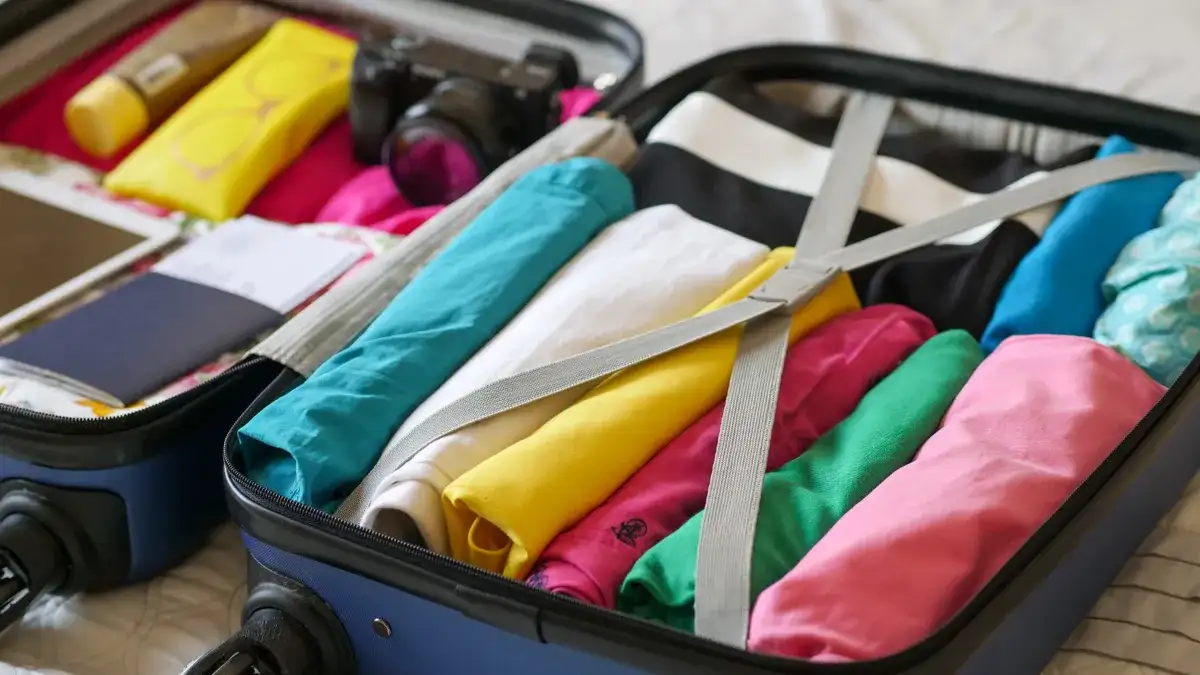
The right setup depends on what you are carrying and how often you need to move it. A rigid roller wins for neat packing and protection. A backpack wins for stairs, trains, and crowded transfers. A duffel wins for irregular shapes and extra flexibility. None is universally best, and pretending otherwise is how people end up fighting their luggage at every transfer.
If you travel for work with a laptop, charger, documents, and one clean outfit, a spinner or structured backpack is usually the cleanest solution. You need predictable access and enough organization to avoid unpacking on the floor of a gate area. If you travel with children, the winning setup often changes by hour: a personal item with quick-access pockets can matter more than the main bag because snacks, wipes, and a spare shirt need to come out fast. If you carry photography or medical equipment, padding and compartment layout outrank everything else.
The common mistake is buying for a fantasy trip. Someone imagines “weekend city break,” then discovers the real pattern is winter travel, shared baggage, or a packable coat that eats half the volume. Another mistake is choosing the lightest bag without thinking about access. A featherweight shell can be miserable if the interior is a single dark cavity and every item has to be stacked in perfect order.
A good fit also depends on airline behavior. Some carriers are generous with overhead space; others are not. On fuller flights, a bag that slips under the seat becomes more valuable than a larger case that technically qualifies but may still be gate-checked. The better choice is often the bag that gives you two viable positions: overhead when possible, under-seat when needed.
If the bag will be lifted often, the handle and wheel setup matter as much as the shell. If the bag will stay in a trunk or storage compartment for most of the trip, structure and protection matter more than handle comfort. The point is not to find the “best” bag in the abstract. The point is to remove friction from the specific trip you keep taking.
The hard-shell spinner: who should use it and who should skip it
A hard-shell spinner wins for travelers who want protection, cleaner packing, and easy rolling through airports. A structured spinner is often the strongest fit for business travel, minimalist packing, and trips where neatness matters more than flexibility. A typical 20- to 22-inch spinner from major luggage brands often follows common airline-friendly dimensions, though exact compliance still depends on the carrier and the model’s handles, wheels, and shell shape.
Its biggest strength is structure. A rigid shell protects a laptop sleeve, cosmetics case, dress shoes, or a camera body better than a floppy bag. Compression straps and a clamshell opening make it easy to separate clean and dirty items. For people who pack outfits by day, this can save real time at a hotel. The four-wheel design also reduces arm strain in long terminals because the bag rolls upright rather than dragging behind you.
The weaknesses are just as real. A spinner can waste space if your load is uneven or oddly shaped. A rigid shell will not forgive overpacking. If you need to fit baby gear, bulky souvenirs, or a puffy winter layer, the shell becomes the enemy. It can also be awkward on uneven pavement, cobblestones, or stairs, where two-wheel drag systems behave better. And while hard shells protect contents, they do not protect your shoulders from lifting a fully packed case into an overhead bin.
This option is wrong for travelers who need maximum flexibility, especially those packing sports equipment, medical supplies in different sizes, or anything that expands during the trip. It is also the wrong first choice if you regularly rely on under-seat space, because many hard-shell spinners are built to maximize overhead-bin volume rather than footwell compatibility.
Look for a spinner if your pattern is one bag, one or two outfits, and predictable access. Skip it if your trip keeps changing shape after you pack. If you want a branded starting point, many large luggage makers sell 20- and 22-inch spinners through brand sites, Amazon, and big-box retailers such as Best Buy or Walmart; the category matters more than the store.
The backpack and duffel route: who it helps most
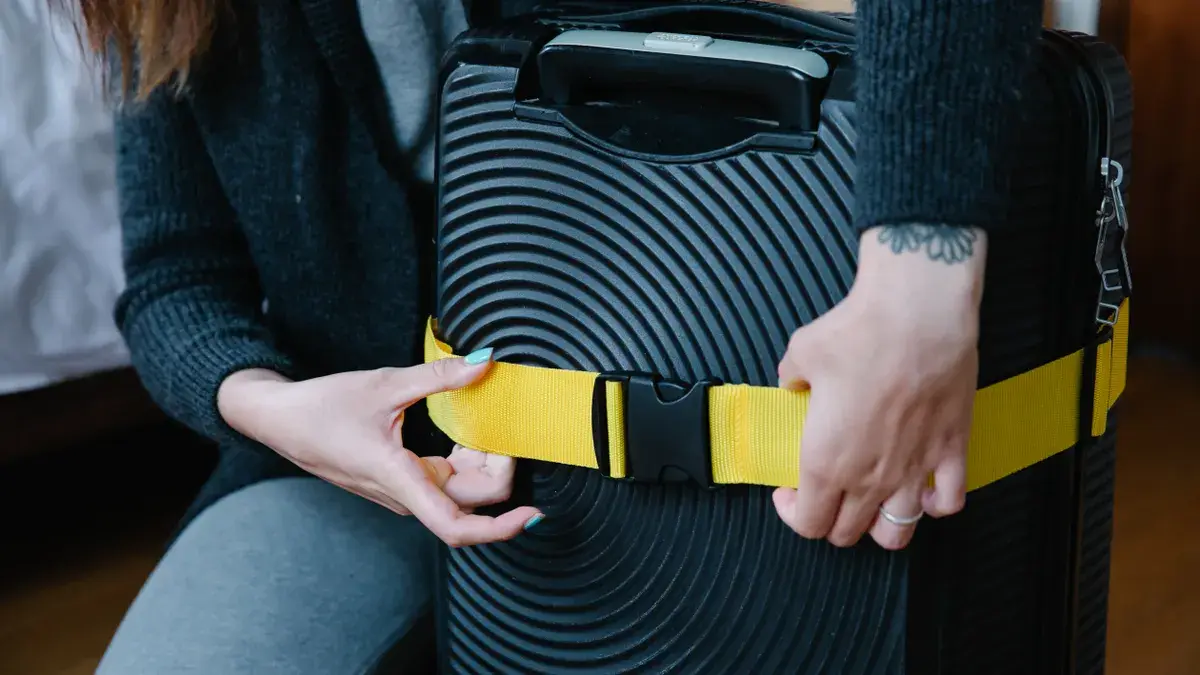
A backpack or duffel wins for travelers who need mobility, flexibility, or easy access in tight spaces. This is the stronger choice for trains, stair-heavy itineraries, parent travel, short hops, and trips where a single awkward item can ruin a rigid suitcase layout. It is also the better choice for anyone who wants to keep both hands free while moving through stations, buses, or city streets.
Backpacks shine because they distribute weight across both shoulders and keep the load compact against your body. That matters when elevators are scarce or when you need to climb into a van, board a commuter train, or walk several blocks with luggage in tow. A well-designed travel backpack with a clamshell opening gives you much of the same packing access as a suitcase, but with a tighter footprint. A duffel wins when the contents are soft, variable, or unusually shaped. It will swallow a puffer jacket, a pair of shoes, and a toiletries kit more gracefully than a molded shell.
The trade-offs are obvious and should not be minimized. A backpack can punish your back and shoulders if the load is too heavy or the straps are badly designed. Even a good one becomes annoying once it crosses a certain comfort threshold. A duffel is worse for long carries because it concentrates weight in one hand or on one shoulder unless you use a crossbody strap. Neither is as tidy as a hard-shell spinner, and both can be slower to organize if the interior lacks dedicated pockets.
This setup is not the right answer for travelers who value formalwear protection, maximum crush resistance, or a polished airport look. It is also not ideal if you pack delicate tech without dedicated padding. A camera lens bouncing in a loose duffel is a poor compromise.
The best version of this choice often looks like a hybrid: a travel backpack or wheeled duffel with a structured laptop sleeve, sternum strap, and enough interior organization to separate chargers, snacks, and documents. If the trip involves stairs, buses, or unpredictable ground surfaces, this category often beats a spinner by a wide margin.
The honest side-by-side
A head-to-head comparison only helps if the criteria actually change the decision. The table below keeps the focus on the things that matter most.
| Criteria | Hard-Shell Spinner | Backpack or Duffel | Winner for [condition] |
|---|---|---|---|
| Protection for fragile items | Rigid sides help shield contents from crush and impact | Softer walls offer less protection unless padded | Hard-shell spinner for laptops, cosmetics, and formal shoes |
| Mobility on smooth airport floors | Rolls easily with minimal effort | Backpack is hands-free; duffel is carried, not rolled | Spinner for long terminal walks |
| Stairs, buses, rough sidewalks | Awkward to drag or lift frequently | Better when carried close to the body or in hand | Backpack or duffel for transit-heavy trips |
| Packing flexibility | Fixed shape can waste space on odd items | Expands around irregular shapes | Backpack or duffel for bulky layers and gear |
| Organization and quick access | Clamshell packing is orderly but can be rigid | Pockets and top access can be faster | Backpack for frequent in-transit access |
| Under-seat compatibility | Often poor unless the bag is a true small cabin size | More likely to compress into tight spaces | Backpack or compact duffel for under-seat use |
| Shoulder and back load | Minimal shoulder strain, but lifting is still hard | Weight can become uncomfortable over time | Spinner for travelers avoiding shoulder carry |
| Formalwear packing | Better structure keeps outfits flatter | Wrinkles more easily unless packed carefully | Spinner for suits, dresses, and dress shoes |
| Trip volatility | Less forgiving if the load changes after packing | Adapts better when you pick up items along the way | Backpack or duffel for uncertain itineraries |
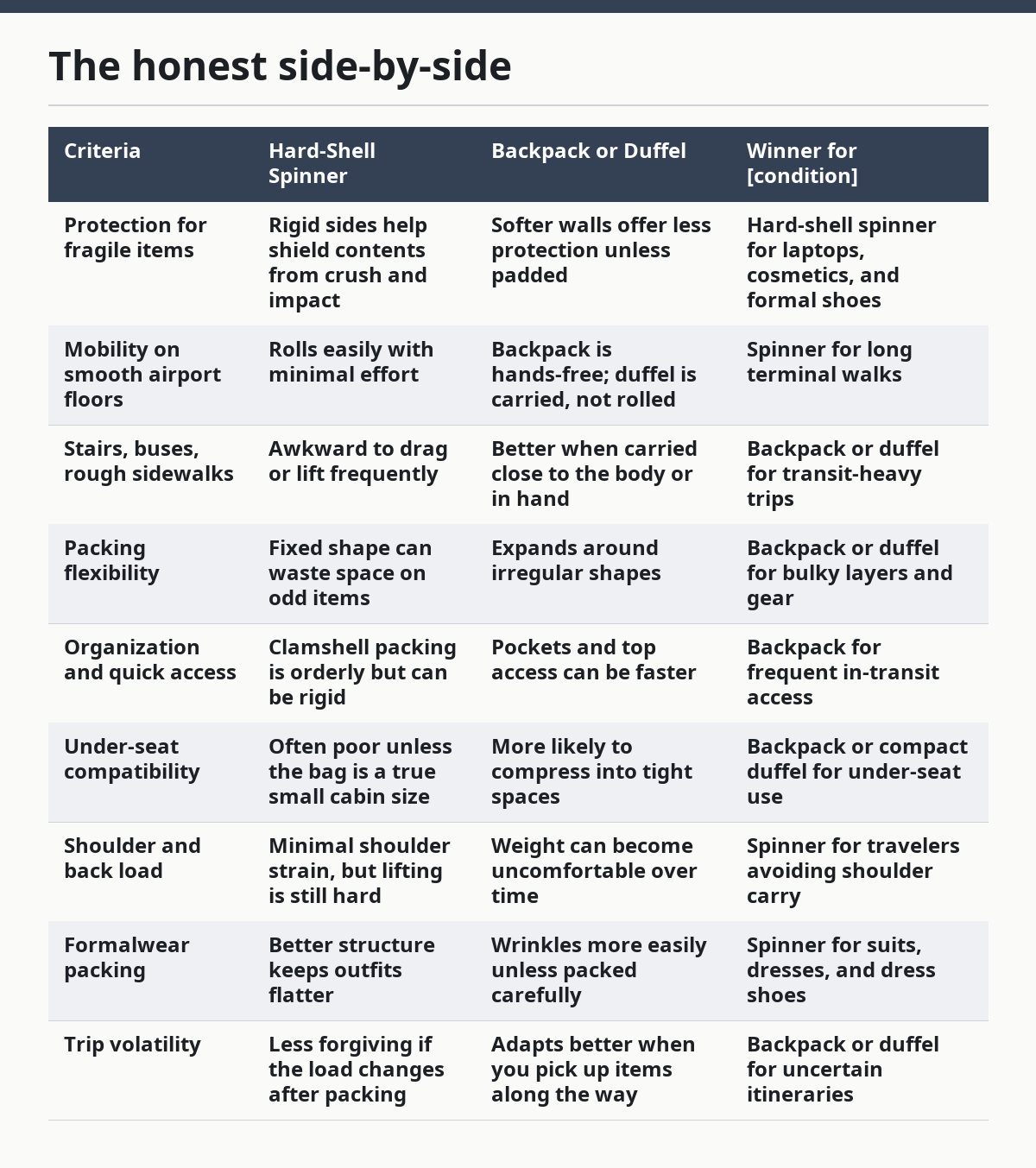
The table points to a simple rule: the spinner wins when order, protection, and smooth floors matter most. The backpack or duffel wins when flexibility, stairs, and hands-free movement matter more. Neither wins every row, and that is exactly the point. A traveler who values only one category often ends up regretting the other eight.
One more practical detail: if you are comparing real products, check current availability from more than one retailer. Brand sites, Amazon, Walmart, and Best Buy often carry overlapping models, but the exact dimensions and interior layout can differ by version. The listing should show the official exterior measurements, not just a marketing name.
Carry-on optimization for specific traveler needs and special cases
A tailored setup wins here because the contents matter more than the bag shape. Business travelers usually need structure. Parents need access. Travelers managing medications or mobility issues need reliability and easy retrieval. Each use case changes the packing logic enough that generic advice becomes useless.
For business travel, the best setup is usually a structured spinner or a compact backpack with a dedicated laptop compartment. The reason is simple: work travel punishes rummaging. If a charger, passport, boarding pass, and laptop all share the same cavity, the trip becomes a series of small searches. A clamshell bag with a padded sleeve keeps the essentials visible and reduces the chance of wrinkles in business clothes. A garment folder can help, but it should not be the main plan unless formalwear is the trip’s purpose.
For parent travel, a larger personal item is often better than a bigger roller. That sounds counterintuitive until the packing list is considered. Wipes, snacks, a change of clothes, a small toy, diapers, and medication all need fast access. A bag with multiple external pockets and one-hand opening is worth more than a pristine shell. The weakness is that this kind of bag can become chaotic quickly, so the interior must be easy to reset. A bag that opens wide and stands on its own is helpful. A bag with one deep black pit is not.
For medical needs, the bag should make critical items impossible to bury. A prescription pouch, a clearly labeled compartment, and a setup that keeps medications in the carried item rather than checked baggage matter far more than style. The TSA page on medically necessary liquids and medications explains the basics of screening and exceptions better than most packing guides, and travelers should read it before flying with syringes, liquid medicine, or cooling supplies. If a prescription item is temperature-sensitive or time-critical, medical advice from a clinician or pharmacist matters more than any luggage recommendation.
These are the cases where the wrong bag creates real consequences: missed medication, a child’s meltdown, a delayed meeting, or a crushed device. The bag is not just storage; it is a workflow tool. That is why the “best” option changes so sharply by traveler type.
Exception scenarios that flip the recommendation
The overall recommendation flips when the trip breaks the normal pattern. These cases deserve a different answer because the default choice starts failing.
Before you choose a spinner, choose a backpack if the trip involves stairs, transit transfers, or uneven streets for most of the journey. In a city with subway stairs, a rolling case can become dead weight. A 40-liter travel backpack with a hip belt may still be heavy, but it keeps the hands free and the load stable.
Next, choose a duffel over both if you are carrying unusually bulky but soft items, such as winter layers, team gear, or a baby’s full kit. A duffel wastes less space on irregular shapes and can squeeze into awkward storage areas. The downside is comfort, so this only works if the carry distance is short.
Then, choose a smaller under-seat bag instead of a full overhead-bin carry-on if your airline is strict, your route is full, or you hate gate-check risk. This is the right call for short trips where the main advantage is certainty, not volume. A compact personal item can be a better travel strategy than a larger cabin case that may still get tagged.
Finally, choose a soft-sided hybrid if you need both structure and give. Some travelers need a bag that can sit in the overhead bin like a suitcase but still flex around last-minute additions. A hybrid is not perfect at anything, but it can be the least bad choice for volatile itineraries.
These are the moments when common advice falls apart. The key is not to ask “Which bag is best?” but “What is the trip most likely to punish?”
How to pack smarter once the bag is right
The bag only solves half the problem. Packing method determines whether the same bag feels generous or cramped. A good system starts with the heaviest items close to the wheels or back panel so the bag stays balanced. Shoes go low and toward the outer edge in a roller, or flat against the back panel in a backpack. Chargers, cables, and toiletries belong in pouches because loose small items waste space and create friction every time you unpack.
Compression cubes help when clothing is the main load, but they are not magic. They reduce bulk more than weight, and they work best with soft fabrics, not stiff jackets. Packing cubes are less useful when the bag is already rigid and the trip includes many small non-clothing items. In that case, clear pouches or flat zip bags may beat cubes because they give faster access.
A reader who is trying to optimize for business travel should think in outfits, not garments. A reader packing for a child should think in access layers: emergency items on top, convenience items in outer pockets, backup clothing in the main compartment. A reader carrying medication should think in redundancy: one place for the immediate dose and one place for the backup supply, assuming the medication and the prescription rules allow that arrangement.
The cleanest packing rule is to stop at 80 to 90 percent of the bag’s usable volume. Overfilling destroys access, makes zippers fail faster, and turns the trip into a wrestling match. If the bag only works when packed to the zipper seam, it is too small for the actual trip.
For airport rules, the TSA liquids standard remains the familiar 3-1-1 framework for carry-on-sized toiletries, and travelers with medical items should check the agency’s medical screening guidance before they depart. For larger prohibited items and packing restrictions, FAA PackSafe remains the clearest public reference for what belongs in the cabin and what does not.
The verdict: which setup to choose and why
Choose a hard-shell spinner if your main goal is orderly packing, protection for fragile contents, and easy rolling on smooth airport floors. Choose a backpack or duffel if your trip involves stairs, transit, unpredictable surfaces, or items that do not fit a rigid shell well. Neither if you expect the same bag to solve a formal business trip, a parent’s supply haul, and a camera run all at once.
The decision is not about status or brand. It is about friction. If the bag will be lifted more than it will be rolled, pick the one that carries better. If the contents need structure more than flexibility, pick the one that protects better. If the airline is strict and the trip is short, size down and keep the load visible and simple. The best carry-on setup is the one that makes the trip easier before you even leave home.
If the pattern is still unclear, use this final test: what would annoy you more at 6 a.m. in the terminal — a bag that does not roll well, or a bag that does not hold the things you actually need? The answer usually points to the right choice.
Drafted with AI; not yet reviewed by a person.




Leave a Reply